
I’ve given a talk about Wardley Maps and technology strategy at at the annual SBB DevDay ’26. The talk shows how Wardley maps can be used in the domain of passenger information and AI.
Category: Technology & Society
Alternatives to US Tech Exist
Since the beginning of the new Trump administration, anxiety about U.S. tech dominance has been on the rise. Over the past few decades Europe’s position as a technology leader has slipped, and most of the continent’s biggest corporations now operate outside the core tech arena. Today the two unmistakable European tech giants are ASML and SAP. The internet revolution was largely handed over to American firms, with perhaps the lone notable exception of Spotify. Even though talent is abundant across Europe, many promising entrepreneurs choose to relocate to the United States. Still, a number of home‑grown companies are showing real promise; examples include Mistral, a cutting‑edge AI startup, and OV Cloud, a cloud‑infrastructure provider. If Europe wants to stay relevant on the global stage, it must rebuild a vibrant technology ecosystem.
One practical way we can contribute is by adopting local alternatives whenever possible. Switching costs for many services are surprisingly low—for instance, moving away from the Google Workspace suite can be done with little effort (except maybe for the email address). Proton.me is a compelling alternative. I plan to transition all of my non‑email workflows to Proton’s suite, and if the experience proves solid I’ll eventually move my email there as well. There’s much to like about Proton: The company was founded by scientists, which gives it a research‑driven, privacy‑first mindset. Its security‑focused architecture protects data from the ground up. Strong branding adds to its appeal. The name “Proton” is well chosen, and the Lumo mascot (the cat) whimsically recalls the vibe of games like Monument Valley.
A sizable portion of Europe’s tech talent already works for U.S. firms that have European offices—think Google in Zürich or Microsoft in Dublin. If a truly competitive European tech sector emerges, offering salaries and growth prospects on par with Silicon Valley, those professionals could switch quickly. The bottleneck isn’t a lack of talent; it’s the absence of European companies that appeal to this talent. That could change dramatically once the sector gains momentum.
Europe still possesses the expertise, the research institutions, and the entrepreneurial spirit needed to compete globally. Europe has a fragmented market and more regulations than the US, which is a structural disadvantage. However, a new structural advantage may be emerging: greater predictability and stability.
There may also be an opportunity to rethink services and product for AI. Doing this on existing mature products may be harder than on new products. The ideal outcome of a European Tech Renaissance would be new, AI‑first products built from the ground up.
GDP: A Brief but Affectionate History
I’ve been reading the book GDP: A Brief but Affectionate History, and it’s been a great way to deepen my understanding of what GDP really measures—and, perhaps more importantly, what it doesn’t.
Gross Domestic Product (GDP) is the standard metric used to assess a country’s economic performance. It sums up the total value of all goods and services produced within a country over a specific time period. The most widely used formula is:
GDP = C + I + G + (E – M)
Here, C stands for consumption, I for investment, G for government spending, E for exports, and M for imports. This equation captures total demand for a nation’s output, whether from households, businesses, the government, or foreign buyers.
While GDP is a useful snapshot of economic activity, the book explores its many limitations. One way to understand these issues is through concrete examples.
Imagine you spent $100,000 in 2010 and $110,000 in 2020. Does that mean you consumed more, or did prices simply rise? In other words, how much of the increase reflects real growth, and how much is just inflation? Adjusting for inflation is relatively straightforward for basic goods like bread or gasoline, where price data is readily available. But for complex goods or services—like smartphones, healthcare, or education—it becomes much harder. How do you measure quality improvements or innovation? A phone that costs the same but does ten times more than it did a decade ago complicates the picture. This kind of change is a kind of “disinflation,” but it’s tricky to capture in the numbers.
Another challenge is the value of “invisible” services. If you clean your own house or use a free service like Google Search, your contribution isn’t included in GDP. But if you pay someone to clean, suddenly that activity becomes “economic output.” Even if you tried to include such contributions, how would you price them? Using market equivalents is problematic because gift economies operate under different dynamics than market economies.
More broadly, GDP struggles with distinctions between productive vs. unproductive activity, or cost vs. investment. For instance, in its early days, GDP didn’t include government spending—it was considered a cost, not output. Over time, certain types of spending, like software development, shifted from being recorded as a cost to being treated as an investment. Government services are especially tricky: we can measure how much they cost, but not easily value their outcomes, since they’re not sold on the market.
Then there’s the issue of consumption itself. Not all consumption improves welfare. Spending on heavily processed, unhealthy foods raises GDP but may also lead to long-term health costs. And GDP is silent on environmental degradation. Cutting down forests or burning fossil fuels adds to GDP in the short term, but may reduce the planet’s ability to support future prosperity.
On top of all these conceptual issues, there’s the practical challenge of data quality. GDP depends on large-scale surveys and statistical estimates. No matter how rigorous the methods, there’s always some uncertainty baked into the numbers.
These and other issues are explored in the book, which weaves together history, economics, and policy into an engaging narrative. In the end, understanding the limits of GDP helps us recognize that while it measures activity, it doesn’t necessarily measure progress or well-being. For that, we need to look beyond the numbers.
What is Apple?
Apple has grown into a fascinating company with a diverse range of offerings. Initially known for its computers, it has expanded into various industries. With Apple being the most valuable company in the world according to its market capitalization, it’s worth asking: what is actually Apple now?
It’s a fashion company – Apple has become a fashion staple, with its accessories blending seamlessly into our daily lives. We don’t just use Apple products; we wear them (EarPod, iPhone).
It’s a luxury company – Apple’s products command a premium price tag, appealing to consumers seeking quality and prestige. Interestingly, both the affluent and the everyday consumer use Apple products.
It’s a technology company – At its core, Apple remains a technology powerhouse, continuously pushing the boundaries of innovation with advancements like the M1 chip or VisionPro, a testament to its ongoing commitment to cutting-edge design and functionality.
It’s an entertainment company – Venturing into entertainment with Apple TV and original content production, Apple has diversified its portfolio beyond hardware alone.
It’s a finance company – Apple has financial services like the Apple Store and Apple Pay, showing its ambition to capitalize on its robust market presence. Apple is becoming a bank more and more.
So basically, Apple does a bit of everything, which is pretty interesting!
While many of these products were launched under the leadership of Steve Jobs, others have been initiated under the stewardship of Tim Cook. Cook may not have spearheaded groundbreaking innovations like the iPhone, but his management has propelled Apple to new heights.
Renowned investor Warren Buffett’s strategy typically avoids technology investments due to their intense competition and difficulties in sustaining lasting competitive edges. Instead, he prefers investments in durable goods and services with robust brand loyalty and high switching costs. The evolution of Apple’s identity is noteworthy, particularly as Buffett began investing in the company. Today, Apple stock comprises a significant 70% of his portfolio, marking a notable departure from his traditional investment approach.
Apple’s story is unique and one thing remains certain: its ability to surprise, inspire, and redefine industries will continue to captivate audiences worldwide.
(Style improved with ChatGPT)
Neuromancer
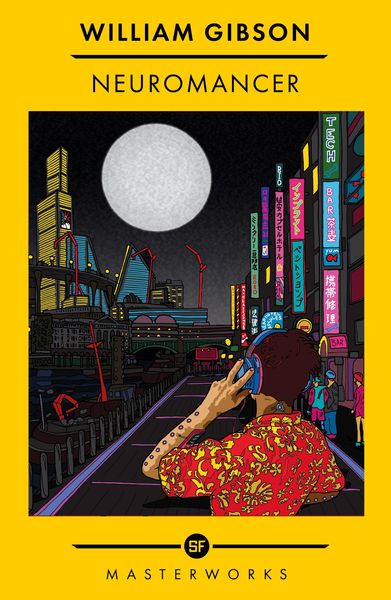
Amidst all the excitement about AI and the metaverse, I recently decided to dive into Neuromancer, the classic sci-fi novel that sparked the cyberpunk genre.
I’d heard it was a big inspiration for The Matrix, so I was curious to see how they compared. While there are definitely similarities, like the matrix itself and the tough, leather-clad female character, the plot diverges distinctly.
Instead of focusing on freeing humanity from the matrix, the book revolves around jailbreaking an AI and merging it with another AI to create a superintelligence. It kind of reminded me of Transcendence, with its futuristic vibe similar to Blade Runner, which came out around the same time as the book.
The writing style is pretty unique, almost like poetry in places, and the story feels like a wild ride. It’s not the easiest read, but it captures well the crazy journey the characters are on.
One thing that stood out to me was how the book portrays the matrix/cyberspace—it’s abstract and undefined, somewhere between VR and a system for visualizing information, kind of like augmented reality today.
It’s also somewhat ironic is that despite its visionary themes, Neuromancer didn’t foresee wireless communication. The protagonist constantly “jacks in” and “jacks out”, relying on physical cables.
It’s pretty wild to think that this book was written back in 1982, considering it tackles themes like AI and the metaverse that are becoming such big topics in 2024. Apple released its first VR set, AI got mainstream, and discussions about the risks of AI are hotter than ever. Neuromancer’s foresight is pretty impressive, making it a classic worth revisiting.
(Blog post style improved with ChatGPT)
Scarcity is the Mother of Invention
The original proverb is “Necessity is the mother of invention.” But as we explore the ways we innovate, it’s clear that scarcity rather than necessity plays a big role in sparking creativity. Indeed, if you’re in need of something abundant, you won’t be innovative. It’s scarcity that prompts us to think differently and find new ways to solve problems.
Scarcity affects many parts of our lives: from time and labor to energy, food, and attention. Each scarcity challenges us to think creatively and come up with new solutions.
Time is something we all wish we had more of. Anything that helps us save time or use it better becomes really valuable. Tools like ChatGPT make communication and problem-solving faster and easier. And platforms with good content save us from wasting time on things we don’t enjoy.
When there aren’t enough people to do the work, organizations have to find ways to be more productive. Digitalization, for example, helps streamline processes and automate tasks. In fields like transportation – where I’m working – , automation helps deal with staffing shortages, like in traffic dispatching.
Other resources, like energy and attention, are also scarce because we only have so much time and focus to go around. Using energy efficiently saves us money and time, while managing attention effectively helps us stay focused on what’s important.
When resources are scarce, we naturally start looking for other options. We switch from human to machine labor, look for renewable energy sources, find sustainable food options, and use technology to help manage our attention better.
While necessity might kickstart our creativity, it’s scarcity that really pushes us to innovate.
(The style of the blog post has been improved with ChatGPT, of course)
GDP as Proxy for Progress
The gross domestic product (GDP) measures how much goods and services have been produced in a year. It measures the economic activity of a country and is used as a a proxy to track the standard of living. The higher the GDP per capita, the more goods and services are accessible to the population, the higher is the living standard.
The very good post “What is economic growth?” from ourworldindata.org makes GDP more tangible:
Have a look around yourself right now. Many of the things you see are products that were produced by someone so that you can use them: the trousers you are wearing, the device you are reading this on, the electricity that powers it, the furniture around you, the toilet that is nearby, the sewage system it is connected to, the bus or car or bicycle you took to get where you are, the food you had this morning, the medications you will receive when you get sick, every window in your home, every shirt in your wardrobe, and every book on your shelf.
Over time, the cost of good and service decrease, due to improvement in production. The utility of the good or service remains constant, though. Inversely, for a given price, the utility increases. An affordable car today is way more comfortable, secure, and efficient than a car from ten year ago for the same price. GDP and progress don’t correlate exactly then. A constant GDP could still represent a constant, modest progress. But in practices, progress is manifested by increased GDP per capita.
Using GDP as proxy for standard of living is subject to debates. Besides access to goods and services, standard of living also encompasses dimensions like access to education, access to nature, or access to health care. Different countries and social systems with similar GDP may fare differently on these points. As a crude measure for the whole country or per capita, GDP says little about the distribution. Inequality isn’t well captured by GDP.
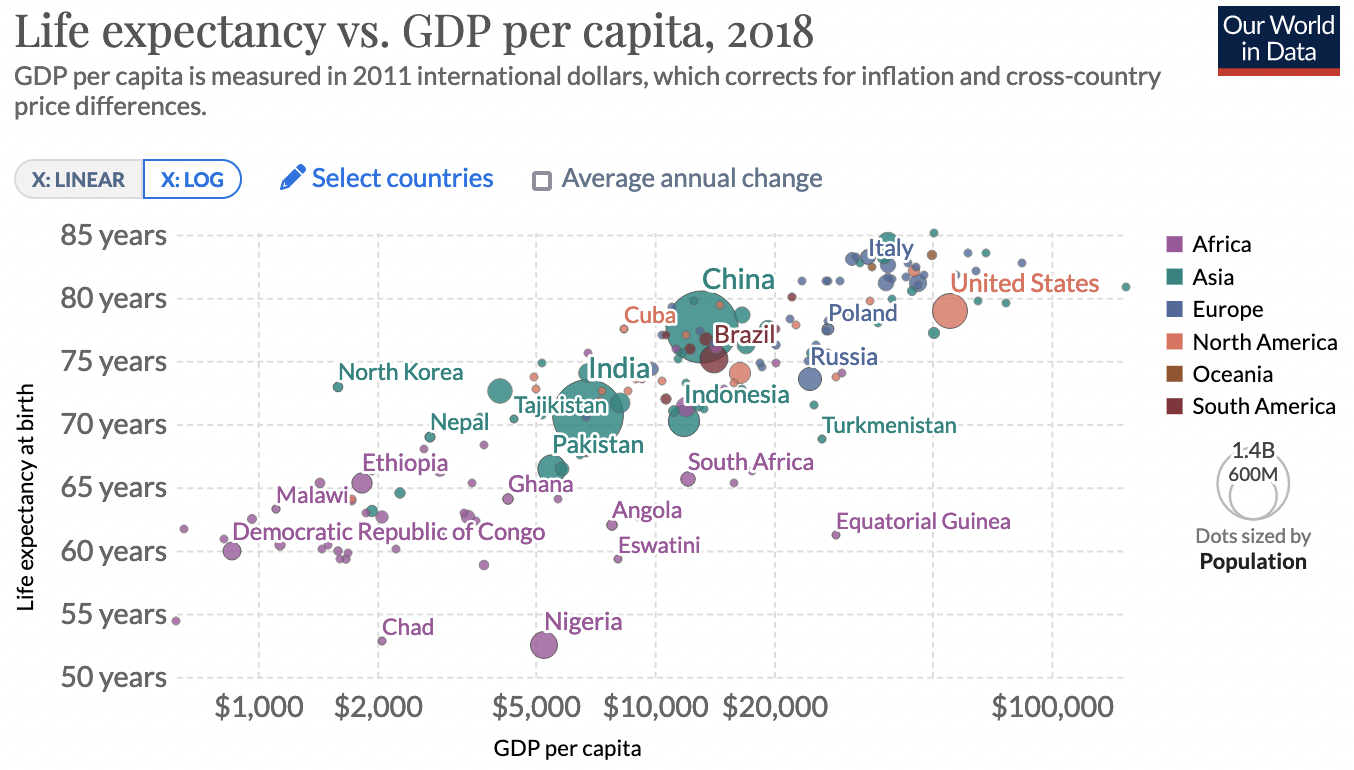
The cousin of GDP to track standard of living is life expectancy. Life expectancy also aggregates and proxies several aspects like education, access to health care, or overall well-being. Interestingly, while both metrics usually correlate, there are discrepancies that remind us that the metrics or only proxies and have flaws.
Ourworldindata.org has an interactive chart to explore GDP and life expectancy:
The GDP is influenced by the household structures. Depending on how GDP is computed, it may or may not contain “services” provided by family members, such as cooking, child care, or taking care of the elderly.
On one hand, it makes sense to include personal activities in the GDP. If you grow your vegetable yourself, you’re working as a farmer with one consumer, yourself. You’re producing some good for yourself. One the other hand, it’s not economic activity – it’s not traded on a market. This activity is not on the market and will not “benefit” from market mechanisms (or rather be “driven” by market forces), such as market-driven specialisation, allocation of resources, or pricing.
In economic logic, growing yourself your vegetable isn’t rational, since you use time that you could have invested in some other more rewarding economic activity, depending on your profession. The same holds for child care: working part-time to raise children isn’t economically rational if you have a high-paying profession.
The reason people are willing to sacrifice profit for such activities at the moment is leisure and fulfillment. They find an increased happiness at some other level in these activities.
Leisure and fulfillment work at the personal level. Doing more outside of the formal economy also brings benefits to the economy itself: it increases resilience and sustainability. These values are not accounted in classic economy, but maybe should.
Given the flaws of GDP, it’s no surprise that other metrics have been developed to track development, for instance the human development index. But the simplicity of GDP (or life expectancy for that matter) is very attractive. GDP will remain the prevalent metric for the years to come.
Using Technology as Intended
Technology people come in two flavours: generalist and experts. I’m definitively a generalist. I’ve a good grasp of the core concepts being the technologies we use. I’m however lacking the expertise about the details of using them. For this, I rely on experts.
This lack of expertise of the details may even turn out to be an advantage in my position. Technologies have core concepts that support some primary technology use case. With enough knowledge about technical details, it’s possible to use the technology to support other use cases. But it’s almost never a good idea in the long term. The implementation will be fragile to subtle changes in details of the technology, and few people in the organization have enough expertise to maintain such an implementation. If your use case is not supported easily, rethink your problem at some other level. Not knowing too much about the technology means I’m limiting its use to what’s maintainable.
The last example of this kind that I encountered was about container dependencies on openshift. In our current system (not openshift-based), we start the containers using “run levels”. Such a concept doesn’t exist in openshift. You could recreate something similar using init containers and some deep technical knowledge, but it wouldn’t be trivial. Rather than misusing the technology, we will have to solve our problem at another level. The containers should be resilient to random startup order at the application-level.
Other examples from the past include details of object-relational mapping or distributed caching. Here too I believe that beeing “too smart” about using the technology isn’t good in the the long term. It’s better to stick to the common use cases and change the design at the application-level if necessary.
Sometimes some part of the design may leverage deep technological details. I’m not completely forbidding it. Used in strategic places and encapsulated in proper technology component, this is a viable strategy. We have for instance engineered a library for leader election based on the solace messaging middleware, that relies on a deep expertise of the semantics of queues in solace. This was a strategic decision and the library is maintained by a team of technology experts with proper knowhow and the support from solace itself. But such situations should be exceptions rather than the norm.
It’s hard to resist the appeal of a clever technology-based solution, but as engineers we absolutely should. When we misuse technologies, we paint ourselves in a corner.
Prisoners of Geography


The main argument of “Prisoner of Geography” as well its sequel “The Power of Geography” (both from Tim Marshall) is that countries seek to expand up to the geographical boundaries optimal for their defense – mountain ranges, lake, deserts, or small plain corridors. Beyond the boundaries of territorial sovereignty, countries aim at projecting power to secure trade and create leverage (“sphere of influence”). Relationships between countries are power relationship, and the one with the upper hand sets the conditions.
Its through this prism that both books look at the history and geography of countries like Russia, China, USA, India, but also regions like Western Europe, the Arctic, the Sahel, or even Space. The books are really good explanation of geopolitics and give an excellent overview of the current state of affair worldwide.
Geopolitics evolve on the timescale of decades or centuries. What may seem stable in one lifetime may still be moving, albeit slowly. Countries take decades for instance to build state capacity or modernize military. A bit like with plate tectonics and earthquakes, the tectonics of power projection results occasionally in conflict and war.
Technology is also a slow-moving process that influences geopolitics. Some geographical barriers like mountains or distance are changing in relevance as technology progresses. Natural resources defined by the geography, too.
Ethnic groups do not always align with nation-states. Maybe alignment is actually the exception to the norm. When it comes to geopolitics, security will always win over human rights. Ethnicity is instrumented in all kinds of ways: minorities in foreign countries are used to weaken the sovereignty of the foreign country; in the home country, minorities are kept under checked (if not oppressed or worse) to prevent separatist movement. Trade and migration can be instrumented to influence the ethnic mix over the long time. We see this instrumentation of ethnicity very well with the war in Ukraine.
Not all nations in the world are equally stable. Some nations have existed from long time and the sense of belonging is strong (e.g. China Han). Some are the result of recent conflicts and still trying to figure out who they are. The power balance is changing, and 50 years from now, we can expect the world to be quite different.
Superficially Silly Ideas Can be Game-Changers
When Twitter appeared more than a decade ago, I though it was silly. I saw little value in a service that only allowed sharing 140-character long text messages. I registered on a bunch of social media platforms and created nevertheless a twitter account. Some years later, the only social media platform I’m actively using is… twitter.
There’s a lesson here for me and it’s that it’s hard to predict what will succeed. A lot of products can appear silly or superficial at first. They may appear so in the current time frame, but this can change in the future. Initially, twitter was full of people microblogging their life. It was boring. But it morphed in a platform that is useful to follow the news.
A startup like mighty can look silly now – why would you stream your browser from a powerful computer in the cloud? But as applications are ported to the web, maybe the boundary between thin client and server will move again.
We prefer to endorse project that appear profound and ethical, like supporting green energy, or reducing poverty. Product ideas that are silly or superficial don’t match these criterion and it’s easy to dismiss them. But innovation happens often because of such products. No matter how silly or superficial you think they are, if they gain traction, they need to solve their problem well at scale. These products are incubators for other technologies that can be used in other contexts. Twitter, for instance, open sourced several components. If Mighty gains traction, it might lead to new protocols for low-latency interactive streaming interfaces. An obvious candidate for such a technology could be set-top TV boxes.
These products might appears superficial at first and might lack the “credibility” of other domains, but here too, the first impression might be misguiding. A platform like twitter can support free speech and democracy (sure, there are problems with the platform, but it at least showed there are other ways to have public discourse). A product like Mighty might in turn make it more affordable to own computers for poor people, since it minimizes hardware requirements. Because these product don’t have an “noble” goal initially attached to them, doesn’t mean they don’t serve noble cause in the long term.
There are of course silly ideas that are simply silly and will fail. But the difference between products that are superficially silly and truly silly is not obvious. I took in this text the example of twitter and mighty. In retrospect, the case for twitter is clear. For mighty, I still don’t know. The idea puzzles me because it’s at the boundary.
More
Update 13.11.2022
- Hacker News thread “I decided to stop working on Mighty” . So I guess it settles the case.

