We have all been faced with someone jumping to conclusions. Less obvious, but just as common, is jumping to solutions.
You jump to conclusions when you overlook facts and alternative explanations. You jump to solutions when you overlook the problem itself and the many ways it could be approached. Both come from the same impulse to move fast and feel done.
Jumping to a solution can be costly. There is the obvious opportunity cost. Are you solving the most valuable problem? Is there even a real problem there? On top of that, the solution you rushed into might be the wrong one, or a decent one that crowds out a much better option you never explored.
You also miss a lot of the fun. Exploring the problem space is often the most interesting part of the work. That is where insights appear and where you actually learn something. If you jump too fast, you skip that phase entirely and turn the work into execution only.
Finally, you risk losing buy in. When you arrive with a fully formed solution, especially if you did it alone, people rarely feel ownership. At best they disengage. At worst they push back. Most people want a voice in how problems are framed and solved.
This is a lesson I keep relearning. Bring problems, not solutions.
For many years I tried to come up with a clever system to organize my digital life.
I explored systems with folder structures, categories, labels, and nomenclature. Now, I’m convinced that the simplest and most effective approach is also the least ambitious one. Go chronological.
Forget about building complex structures that should work now and in ten years. Just store everything by year. Inside each year, create a handful of buckets using whatever grouping makes sense at the time. Taxes, pictures, projects, information, things that matter at the moment. Usually you end up with five to twenty buckets.
Life changes, and this approach deals with that naturally. You do not need a future proof system. Each year stands on its own and can use its own categories. Time provides the only stable axis.
At first, retrieval sounds inefficient. In practice it works surprisingly well. Most of the time you know the year. Once you have that, finding the right bucket is either straightforward or a matter of a few clicks. Within one year, misclassification isn’t an issue. Even if you need to check a couple of nearby years and the buckets look slightly different, it is still no big deal. The approach trades classification purity with simplicity.
Searching across many years can be less convenient, but this happens rarely. And when it does, full text search exists.
Archiving is trivial. A year is done, you close it, and you move on.
Truly long lasting projects can live outside of this structure, but they should be the exception. Recurring administrative topics do not qualify.
There is also something quietly profound in all of this. Even in a long career, you will likely end up with sixty to eighty yearly folders. That is a small enough number to manage without much effort. Your life is actually short.
With 2026 around the corner, it is time to create a new folder and start bucketing again.
After five years in the role and experience with two different ARTs, it feels like a good time to reflect on what the System Architect role really means in SAFe.
The main responsibility of the System Architect is to align teams around a shared architectural vision and to plan the necessary architecture work together with the teams through enablers.
In SAFe, the Product Manager acts more like a project manager who plans the work but doesn’t own the roadmap content. Business features and epics usually come from the business side. The System Architect, on the other hand, owns the architectural enablers and works closely with the PM and POs to plan their realization.
Architecture itself is a large and multifaceted area. I find the definitions of enablers and the architectural runway somewhat unclear. Platforms are clearly enablers, but it’s less obvious whether something like an interface qualifies as one. The term “architecture runway” is essentially another way to describe architectural foundations. In practice, architectural work often relates to technology—such as platforms, services, and cross-cutting concerns—but it can also include non-technical elements, like core data models.
In modern architecture, application architecture and application delivery are tightly connected. SAFe includes the promotion of DevOps practices as part of the architect’s work. The framework does not prescribe specific architectural artefacts, so documents like system architecture descriptions, quality reports, or technical debt tracking sheets must be shaped by the context and the needs of the ART.
While the System Architect is responsible for communicating the architectural vision and owning the enablers, the way this work is carried out can vary a lot. The architect may act as a facilitator who brings people together to clarify architectural needs and focuses on managing the architectural effort. The architect may also take a designer role, setting a clear direction and focusing on the overall system design. In both cases, during implementation the architect may work closely with the teams as a partner or delegate the work fully, depending on the situation.
Unlike the PM and RTE, who have clear counterparts at the team level (PO and Scrum Master), the System Architect does not. In Scrum, the entire development team shares responsibility for architecture, which can make alignment and collaboration more challenging.
Part of the System Architect’s work is to identify the right challenges for the ART and address them in the right way. These challenges can look very different depending on how the ART is set up. If several teams work on a single product, there are shared architectural foundations that cut across teams, and coordinating changes becomes essential. If the ART has teams working on separate products but using shared platforms, alignment is still needed but in a more subtle way, since teams have more freedom in how they work. If teams build independent products on different platforms, the main challenge becomes managing that diversity and keeping the overall architecture coherent where it matters.
What success means for a System Architect depends on the product portfolio, the IT strategy, the architect’s skills, the teams’ maturity, and the culture within the ART. But in every case, success comes from shaping the architecture in a way that helps the ART deliver real value, not from following a fixed recipe.
Each year, I try to give a talk at the internal SBB Developer Conference, called “SBB DevDay”). The previous years, I gave talks about concrete technology challenges. This year I tried something new and gave a talk about development methods and practices.
I consolidated my experience and insights of the past 6 year as lead architect into a useful framework to think about software architecture governance. This perspective mixes traditional agile concepts with concepts of choice architecture.
An interesting aspect of the SAFe framework is that it tries to combine two agile mindsets. The first mindset is the iterative mindset of methods like Scrum. It’s a cornerstone of agile development and SAFe “scales” it from the team-level to the program-level, for instance with the PI Planning.
Another mindset in SAFe is the lean mindset. The lean mindset is not about iteration, but about optimising the flow of value.
Lean came initially from manufacturing where the goal is to (1) reduce the time to produce physical good, and (2) reduce the “inventory” needed in the process, and (3) reduce the “waste” produced during manufacturing. In manufacturing, managing inventory requires warehousing and logistics, this costs money. Materials that end up as waste cost money too but do not produce value. To reduce delivery time, each step in the delivery process must be optimised and wait time be reduced to the minimum.
These ideas can be translated to the software world if we consider that features under development are “inventory” and the development process is a pipeline that can be optimised. Features under development are “inventory” since they don’t produce value but must be managed. Waste is a bit harder to map but it represents all the unnecessary work that end up not being used (think of unused design document, analysis, etc.). The development pipeline can take many forms but is always a variation of define, build, verify, and release. The quicker a feature can transition in the pipeline the faster you produce value.
Lean in itself doesn’t require iteration. Iterations are needed to manage uncertainty and course-correct the product development in the face of new information. Lean is about optimising a delivery process. But the delivery process could be about the delivery of a similar item every time, like cars in the manufacturing world.
But Lean is also a great complement to iterative approaches like Scrum. In this case, the goal of the lean mindset is in a way to optimise the iteration speed. Rather than having several features with long delivery time, focus on few features and short delivery time.
SAFe emphasises the lean mindset with concepts like the continuous delivery pipeline and value stream mapping. Besides presiding over the process, the RTE are also charged to improve the flow of value in the organisation.
The lean mindset isn’t as established as the iterative mindset. I find it interesting that SAFe integrates it and promotes it. We conducted a value stream mapping session at work, and it was very enlightening. Thinking in waiting time, inventory, waste does indeed work in the software world, too.
It’s a simple way to highlight process and organisational issues. It gives clarity to what should be optimised and not get lost in organisation design. Chances are, if you want to reduce waiting time, you will have to solve a bunch of other problems first. The lean mindset positions these problems not as end in themselves, but as bottlenecks to short delivery time. It helps you prioritize these problems. It’s a bit like Test-driven Development (TDD). Making things testable requires that you figure out a good design first. But assessing testability is easier than assessing “good design”. In the case of Lean, minimising “waiting time” requires that you figure out a good organisation first, but measuring “waiting time” is easier than measuring “good organisation”.
Few years ago, I would have described a good organization as one where everyone is on the same page. By it, I would have meant exactly on the same page. I realize now that I was wrong. You don’t need to be perfectly on the same page. Being mostly on the same page is enough, and a little bit a chaos is ok.
Engineers are very well positioned to understand why: to be on the same page you need to coordinate, and coordination is expensive. This holds for actors in a software system (threads, processes) but also actors in an organization (person, teams, units). Coordinating between actors takes time, and as such slows the system. You should first try to design your system so that the need for coordination is reduced, and then if necessary, balance coordination with consistency (being on the same page).
The analogy works surprisingly well (maybe it’s not an analogy but a property of system in general?). Take optimistic locking in software systems: it’s a tradeoff between consistency and performance. Rather than lock the resource on each change, you only check when you do the final write if you’ve been working on the most up to date information. If not, you do a retry. In this case, there’s a performance hit, but overall the system is faster this way. The equivalent in an organization would be to accept that some people somewhere have outdated information. They will work based on this outdated information until a synchronization point happens and they realized the information is outdated. Some work will have to be corrected or redone. It may be upsetting, but should happen rarely.
The art of organization design is to reduce coordination and when needed use the right synchronization points. The goal is to prevent catastrophic mistakes. Some inconsistencies here and there, if timely resolved and with small consequences, are fine. Do not synchronize on everything (it’s way too expensive) but synchronize often enough to keep the risks small. Prefer many small risks than looming, large big risks.
There are lots of patterns in software system to synchronize and coordinate actors in the system. There are also a lot of patterns to synchronize and coordinate actors in an organization: all-hand sessions, company memo, internal trainings, review boards, formal processes, team meetings, etc.
Interestingly, software systems and organizations have different profiles when it comes to the tradeoffs between consistency and speed. For software systems, relaxing consistency beyond simple techniques like optimistic locking is usually hard. Transactional systems are still a lot easier to build than systems with relaxed consistency. On the other hand, an organization will always work with relaxed consistency somehow: it’s impossible for an organization to update the “collective brain” in a transaction. It’s the nature of people to misunderstand information, forget things, or simply take vacations or be sick.
Speaking of coordination and alignment, Elon Musk put it like this:
“Every person in your company is a vector. Your progress is determined by the sum of all vectors.” – Elon Musk.
What this analogy does not consider is the time needed to align. If lots of time is lost on coordination, the vectors are smaller. You then have to choose between an expensive perfect alignment, or some inexpensive imperfect alignment. Given that organizations constantly course-correct, vectors accumulate projects after projects (or task after task) and there are plenty of opportunities to adjust the alignment, even each time in an imperfect manner. This is why in a good organization, a little bit of chaos is ok.
SAFe introduces a new role in the industry: the release train engineer (RTE). A RTE is, according to the framework:
The Release Train Engineer (RTE) is a servant leader and coach for the Agile Release Train (ART). The RTE’s major responsibilities are to facilitate the ART events and processes and assist the teams in delivering value. RTEs communicate with stakeholders, escalate impediments, help manage risk, and drive relentless improvement.
The role is designed like a scrum master at the ART level. At a minimum, a RTE ensures that the process is followed. But a good RTE helps teams improve their performance – that’s the essence of the job. A RTE doesn’t have any authority over the content in the backlog. The focus on only on improvement at the organisational level. As such, the wording “assist the teams in delivering value” leaves quite some lattitude in how impactful an RTE can be.
What do you expect from a RTE? I am wondering how this role will establish itself in the industry. Here are my personal expectations.
Level I – The Organizer. The RTE ensures that the process is followed. He/She ensures that information flows between the teams using the elements of the framework. The RTE helps resolve problems related to the work environement as they appear. Example of such problem could be: tools to communicate, organisation of the program backlog, running the ART events. He/She makes sure people can work.
Level II – The Moderator. The RTE is able to create plattforms or use existing plattforms to encourge discussions in the ART / Solution. With some moderation talent, he/she can help instill change, support improvements, or create alignment. The RTE helps resolve problems about team performance as they appear. Example of such problem could be: interpersonal issues, improving the collaboration with a specific provider, managing morale in challenging time, ensuring transparency, suggesting a feature stop to address the existing bugs first.
Level III – The Influencer. The RTE identifies systemic performance issues in the organisation and work towards resolving them by instilling change at the organisation, technical, or product management levels. Example of such issues could be: addressing systemic quality issues due to the work culture, working with the system architects/teams/system team to make the continous delivery pipeline faster, encouraging decentral decision-making (while managing risks), improving feedback loops.
The higher the level, the more interdisciplinary the RTE will have to work. While little knowledge of product management or architecture is needed to be proficient at level I, problems at level II and III will require a good understanding of how engineering works and how product management, technology and processes influence each others. On the technology front, the RTE is also a key stakeholder to support mindset like DevOps, which means he must also have some good understanding of how technology supports delivery and operations.
The RTE role ressembles that of the more established delivery manager. Both focus on similar sets of issues.
The big difference between both roles lies I think in the mindset. A RTE is a coach and as such has little formal authority in itself. He leads by helping other take the right call. A delivery manager will typically have more formal authority. For instance, a RTE has no authority over the priorisation of backlog in itself. The PM and PO have formally this responsability. The RTE coaches the PM/PO in priorizing work.
The higher the level, the more the RTE works at the level of the engineering culture. It’s easy to define values and visions that nobody follows. Culture is defined by how people effectively behaves. It’s hard to be a good RTE. Just like it’s hard to be a good scrum master. Changing how people work isn’t easy.
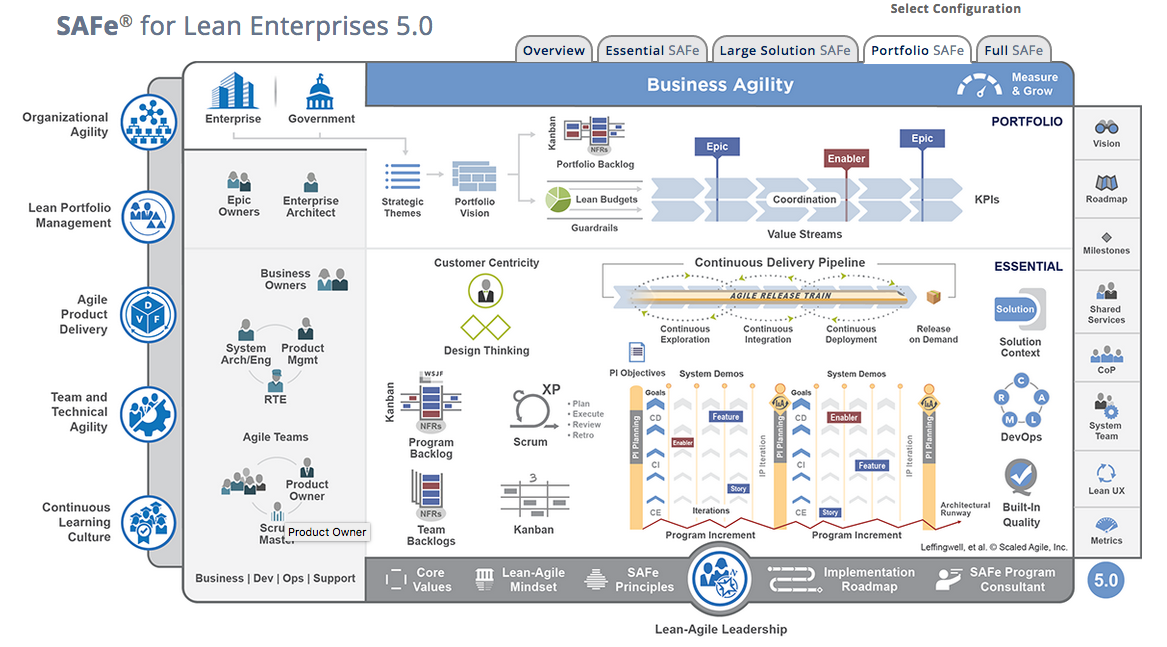
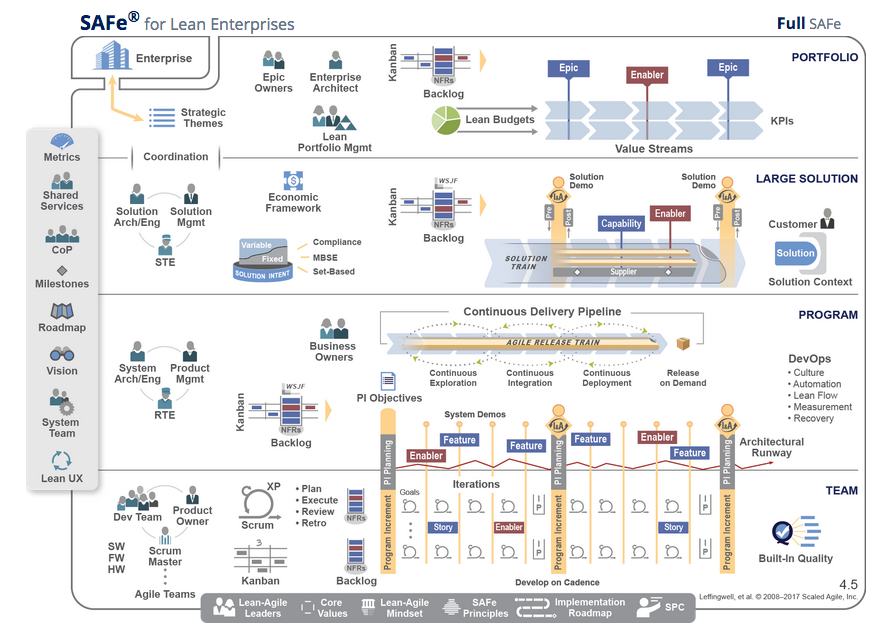
The Scaled Agile Framework (SAFe) is a complex framework. I mean, just look at this picture:
Long is gone the simplicity of Scrum. Its glossary contains 102 items (I counted them!), ranging from obvious concepts like a “story” to esoteric notions like “set-based design” with “customer centricity“ in between. The framework is meant to impose some structure, but at the same time, it has so many elements that with some creativity, you can probably retrofit any organisation in it without changing anything (for instance by abusing the concept of shared services). If agile was meant to be about simplicity, then SAFe is far from it.
SAFe comes in various “configurations”. The picture above is “portfolio” SAFe. And mind you, there is a “full” SAFe configuration which is even more complicated. But the core of SAFe – the “essential” configuration – has actually good parts:
ARTs should align with value streams. You organise you company in ARTs based on how you generate value to your customers so that each ART focuses on one part of the value stream. The definition of value streams is of course complicated in the glossary, with development and operational value streams distinct from each others, but the idea is actually good. You align IT and Business this way.
At the ART level, the leadership is split across three roles: Product Management, System Architecture, Release Train Engineer. I think that this split is a nice point in SAFe. It creates some balance in responsability and makes it clear the to be efficient, you need to address product features, architecture, and work culture together since they all impact each others.
SAFe also introduces a special terminology for things that aren’t features on their own: enablers. Chances are, you had this kind of work item already, just with a different name. But naming matters, and SAFe make a good use of the concept of “enabling” at various level. I like it.
The System Team helps with toolchains, infrastructure, build pipelines, integration testing.
Most companies develop their own organisation when growing, which will have some similar elements. Maybe you have different roles (e.g. “engineering managers”), or different ways to synchronize, or some other way to manage architectural work. Some things are surely different, but some things are probably similar, but named differently, or implemented differently. If you want to move to SAFe, how much you will need to adapt will depend. But for most enterprise, the change isn’t radical.
In this sense, SAFe is as collection of patterns. What SAFe gives you is a standard frame of reference to discuss about these aspects. SAFe establishes a common vocabulary to talk about the organisation and how to improve it. Where this analogy with patterns fails, though, is that you usually can decide to implement some pattern individually. SAFe come as a framework of patterns, where all of them must be implemented.
The „large solution“ configuration adds an additional level of scale with product management, train engineer, and architecture at the solution level. Solution and ARTs have the same cadence and synchronize through the same PI plannings. They have the same program backlog. This makes sense. (Historical note: “Program Level“ was replaced with “Essential” in SAFe 5, but the rest of the “program” terminology survived)
With the “portfolio” configuration, you have an additional level of “lean portfolio management” (LPM) whose goal is to « align strategy, funding and execution ». This adds epic owners, enterprise architects, lean business cases, KPI and the like the framework. According to the framework, only with this configuration can you achieve business agility. Something I like with SAFe is that idea to fund value streams rather than projects.
I understand that this level may match well with existing organizations, with funding systems and steering boards. But the portfolio level still has a bit the feeling of ARTs and Solution Trains as “factories”, divorced from real business accountability. If the goal is to bring IT and business closer to each other, why not push these elements to the ARTs and Solutions? Make them accountable for the value their products generate. In a way, I wished that this level wouldn’t exist, or existed in another form – for instance not beeing an addtional level but rather a vertical that complement the existing levels. I understand that some initiatives will impact several steps in the value stream, and thus possibly several ARTs or Solutions. But I hope it’s the exception, not the norm. On the other hand, maybe that’s also precisely the point of the portofolio level beeing above the Solution / ARTs. If your business (and thus value streams) isn’t yet clearly establisehd, you need another level to be able to shape the value streams based on feedback from the market. I think that the portfolio level will be used very differently from enterprise to enterprise.
In its core values, SAFe recognizes its influences: Agile development, Lean product development, systems thinking, and DevOps. The framework actively tries to combine these influences into a consistent whole. The problem is that it feels sometimes a bit too much: The SAFe core values page lists 4 values. The lean-agile mindset page lists 4 pillars. The SAFe lean-agile principles page lists 10 principles. The lean-agile leadership lists 3 dimensions. Business agility lists 7 competencies that are required (on the left in the picture, but “competency” isn’t in the glossary). I like conceptual frameworks, really. But it’s hard for me to not get lost here.
I guess that companies moving to SAFe will still need to tailor it to their needs anyway. Where I’m working, they added „subject-matter expect“, for instance. That’s fully in the idea of agility- tailor processes when you need it. But with this idea in mind, SAFe could have been kept smaller rather rather than trying to be all encompassing.
It’s very interesting to see how SAFe evolved over the years. The version 2, circa 2013, looked like this:
Some things are worth noting:
There is no large solution. Only Team/Program/Portfolio
At the program, we find release management.
The symmetry between PO/Team/ScrumMaster and PM/Arch/RTE isn’t yet established
Spikes and Refactors, a terminology comming from eXtreme Programming
Epics are primarily characterized as something that spans releases, to be broken down into features that fit in releases
Interestingly, this setup is very like the structure I know from my work.
This is version 3, circa 2014:
There aren’t that many changes compared to v2. The biggest change seems to be the introduction of value streams at the portfolio level. With it comes the ideas that we fund value streams. We also see some “principles” appear, like the House of Lean, the Lean-Agile Leadership, Built-In Quality at the Team Level.
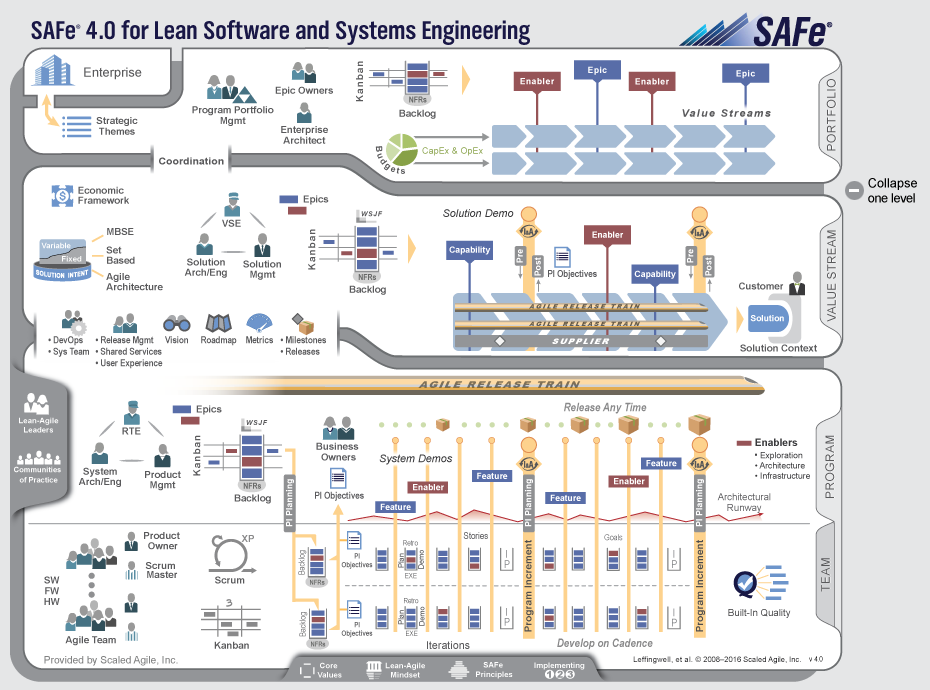
Here is version 4, circa 2016:
Major changes include:
An additional level between program and portfolio: the value stream. The “Solution Train Engineering” from version 5 is a “Value Stream Engineer”. The value stream is very present in this configuration.
The symmetry between PO/Team/SM – PM/Arch/RTE – SolMgmt/Arch/VSE is established
Release management is subsumed with shared services
The introduction of “Business Agility” as the overarching goal, to be achieved with the profolio level.
Introduction of the 7 core competencies (Organizational Agility, etc.)
The levels Program and Team merge into “Essential”.
Some more “principles”: customer-centricity, design thinking.
By studying the evolution of the framework I understand some things better now.
The core of the framework with agile release train and portfolio levels remained quite stable over the years
The large-solution level appeared over time, morphing from the value-stream level. The symmetry between the ART and solution level with the 3 roles PM/Arch/RTE took some time to evolve to how it is now.
The term epic became more complicated to understand. It started as “something bigger than a release” and existed only at the porfolio level. In SAFe 5, epics can occur at all levels.
Supporting artefacts and teams evolved over time, but these were much minor changes. The biggest change was probably the “subsumption” of release management in the shared services.
Principles have generously been added continously to the framework. There are now a lot of them.
Just with anything that evolved, some inconsistencies accumulate. I find it interesting to observe this in domains other than code and architecture. For instance, in SAFe 5 the term “program” is still in use (Program Increment, Program Backlog), but the program level disappeared. This is due to historic reasons. Starting directly with the version 5, you would probably name things differently (e.g. “Solution Increment”). Also just like with code and architecture, the framework suffers from feature creep.
Somehow I’m a bit sad that they decided to go away with the “value stream level”. The idea of value stream is very powerful and putting in at center stage was nice. The version 4 has another spin as version 4.5. from an engineering standpoint. With the “value stream level”, various programs deliver independent products that together realize a value stream. With the terminology “large solution” of version 4.5, you get the impression that you have one “large solution” broken down in several components deliverd by various ARTs, that need to be integrated together. The difference can seem subtile, but I prefer the spin of version 4. The “large solution” terminology will tend towards centralization more than the “value stream” terminology.
As for the principles, there are simply too many of them. I believe that the signal-to-noise-ratio here is too high.
Introducing business agility is an interesting move from SAFe. I expect the discussion “development agility “ vs “business agility “ to be all the rage in the coming years. We know how to do agile development. But we still don’t get the expected outcome at the business level. The link is somehow not that trivial as in theory. Version 5 recognizes this and makes it clear that agile development is a mean to an end, not the end itself. It reminds us why we’re making all this. Here’s there’s a clear signal without noise, and it’s valuable.
People working on a product or system might have different interests and motivations. For someone, it might be shipping as quickly as possible. For another, it might be keeping operations stable. For a third, it might be ensuring adherence to some standard or policy. There are many forces at play, potentially in conflict.
These different incentives inevitably lead to friction at work, since the value of some work is assessed differently.
Most IT projects have been traditionally organized so that such frictions arise because activities and responsibilities are silo’ed.
The goal of most agile development practices it actually to reduce such friction by aligning incentives. That is, make teams of people aim at the same goal.
If you want to reduce bugs and improve quality, make testing part of development. That’s the “definition of done” in agile methods.
If you want to improve stability while shipping new features, involve developpers in operations. That’s DevOps.
If you want to make sure developers care about long term maintenance, make teams responsible of components indefinitely. That’s product over project.
The idea is always the same: make the team responsible end to end. The team as a whole share a set of incentives.
Internally, team members might still value some work differently, based on preference or subjective factors. But chances are that the differences are smaller as with silos and consensus is also achieved easier. The context for all team members is the same and discussions aren’t biases due to individual incentives. The big “wall of confusion” between teams silo’ed by activities is replaced by a more balance approaches of simply weighting the pro and cons and commiting to one decision. A lot of the friction goes away.



 ://ewernli