Development Hygiene

I recently attented three keynotes: Alan Kay and Andreas Kuehlmann at TOOLS and Jeff Kramer at ICSE. Hearing these talks, the software industry seems to be stuck: we don’t know how to move beyond manual development and testing of fine-grained software artefacts. However, as software engineering matures over time, a body of best practices emerges that increases quality of development. For instance, Jeff Kramer showed that certain ideas from the architecture community had indirectly made their way to industry under another form, e.g. dependency injection.

Andreas Kuehlmann used the word hygienic to refer to teams with sound engineering practices. The wikipedia definition of hygiene is a “set of  practices employed as preventative measures to reduce the incidence and spreading of disease”. High hygiene standards favor clean code. Assertions, contracts, refactoring are examples of hygienic practices. Hygienic practices lower the risk that your software become a drity pile of code. I like this analogy with health.

Progress in health promotion didn’t happen in one day. Medical and everyday practices such as sterilization, quarantine, treatment of wastes, dental care take took time to be established. Next to these practices, the healthcare industry enjoyed several breakthrough such as the creation of vaccines, or organ transplants that enabled this remarkable progress. Progress in development is similar to progress in healthcare.

  • Testing hygiene. Unit testing is similar to the daily routine of brushing ones teeth after each meal. It’s a defacto standard practice. Testing hygiene prevents bugs.
  • Code quality hygiene. IDE with code styling enforcement prevent unreadable code from spreading.
  • Modularity hygiene. A vast set of principles help keep software modular and prevent coupling and big balls of mud.
  • I/O hygiene. Sanitize your inputs and protect yourself from a malicious external environment. Don’t disclose sensitive information to the outside.
  • Monitoring hygiene. The first step to stay healthy is to identify problems and remedy before it’s too late. Yearly check-ups are becoming more and more common to detect symptoms of diseases. The same is true for applications, with monitoring, stress tests, and periodic reviews.

Hygiene refers to daily common pratices. Healthcare directly improves with improvement in hygiene, but also needs expert at time. When somebody is sick, he is sent to the hospital to follow a cure. For software, when an unreliable component is detected, it is put in quarantine, then analyzed and fixed with proper tools and techniques.  Expert troubleshooting is the equivalent of surgery.

Finally, what makes software remarkable is that similarly to organisms, software is grown, not built. Also, organisms and software are highly dynamic systems. This makes the analogy even stronger.

Hygienic programmers grow clean code and run healthy software.

MORE

Sandboxed Evaluation

JSON is a data exchange format, and a the same time is valid javascript. You don’t need a parser to read them, and you can use the almighty eval to interpret the data. This is however a security breach. Malicious JSON data could be provide and would be evaluted without further notice. Parsing is therefore still necessary to validate the data. There’s nothing really new there: reflection and security are known to be orthogonal.

It doesn’t need necessary to be the case, though. Reflection could be limited so as to allow what is necessary and deny malicious actions. In the case of JSON evaluation, one should prevent the access to global data, and the creation of new functions. That is possible, e.g. with a custom first-class interpreter. The data might still not be valid JSON data from point of view of the data format, and might contain expressions. More advanced “security” policies could specify execution protocols that would be forbidden, so as to prevent the executions of certain expression, or sequences of expressions.

But then comes the question of error handling. Isn’t it “too late” to catch errors at run-time? An error–even if cought in time–might leave the system in a invalid transient state from which it is hard to recover. Validating the data statically prior any execution seems therefore an easier approach. This is for instance the approach taking by the Java platform: mobile code is verified when loaded.

Checking for potential errors statically is however more restrictive than checking for errors at run-time. Similarly to type systems, valid programs or data might be rejected because of the conservative nature of static checking.

Going back to a dynamic perspective on security, we need a way to (1) catch errors at run-time and (2) recover from errors at run-time. To provide the same level of security as its static counterpart, such an approach should make sure that nothing can happen at run-time that can not be undone. Recovery blocks, transactional memory, and first-class worlds are all techniques to enable undo easily.

What can be recovered must match what is allowed. Undoing changes to memory will not be enough if one can read from I/O streams ; either I/O operations should be denied, or the recovery mechanism should be strong enough to safely undo I/O read and write if needed. Spawning threads might be allowed, if we are able to detect and escape from infinite loop and reliably cancel execution of untrusted code.

Let’s take for instance that case of Java Enterprise Edition (JEE). Applications deployed on JEE application server must obey such specific restrictions. Most constraints arise from the transactional nature of EJBs, and the fact that clustring should be transparent. JEE applications run in a managed environement and should not spawn threads, access static data, performing blocking I/O, etc. they should be side-effect free. The sandboxing facilities of the JVM do not suffice to enforce these constraints, and many of them are conventions. The run-time itself does not prevent messing with the infrastructure.

We need a configurable runtime with adequate programming language abstractions to define and enforce security policies at various level of granularities. Such a runtime should be flexible enough to enforce the safe evaluation of JSON data, and the safe execution of JEE applications.

On Parallel Class Families

I discussed yesterday with Raffael Krebs, a master student at SCG, who was disappointed of his design in Java that lacked extensibility. The main problem was that he wanted parallel class hierachies, which you can’t do easily in Java.

This problem isn’t new. Let’s illustrate the problem and explore a bit the various design in pure Java, then with existing language extension.

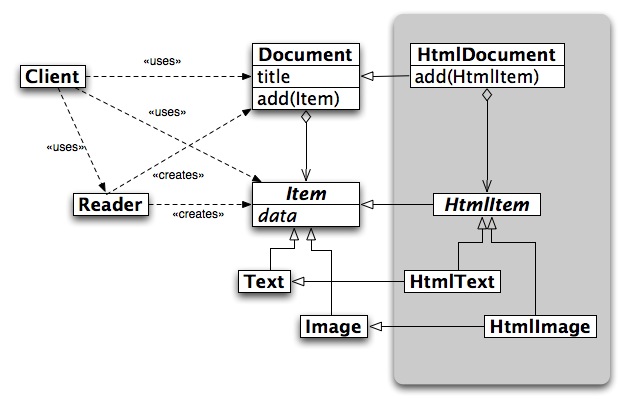
Below is a sample situation. The core of the model is composed of Document, Item, Text and Image. The Reader reads data from a file and creates the model. The client uses the model. To be generic, it must be possible to specialize the model with as little effort as possible, that is, provide reuse in a natural way. One would like conceptually to specialize (that is, subclass) the model for instance for HTML documents.

This conceptual view can not be achieved with Java. There are several problems: (1) multiple inheritance is not supported, (2) the Reader class still references the core model and will not create instance of the more specialized one, and (3) in most statically-type languages, parameters in a subclass must be covariant to those in its superclass.

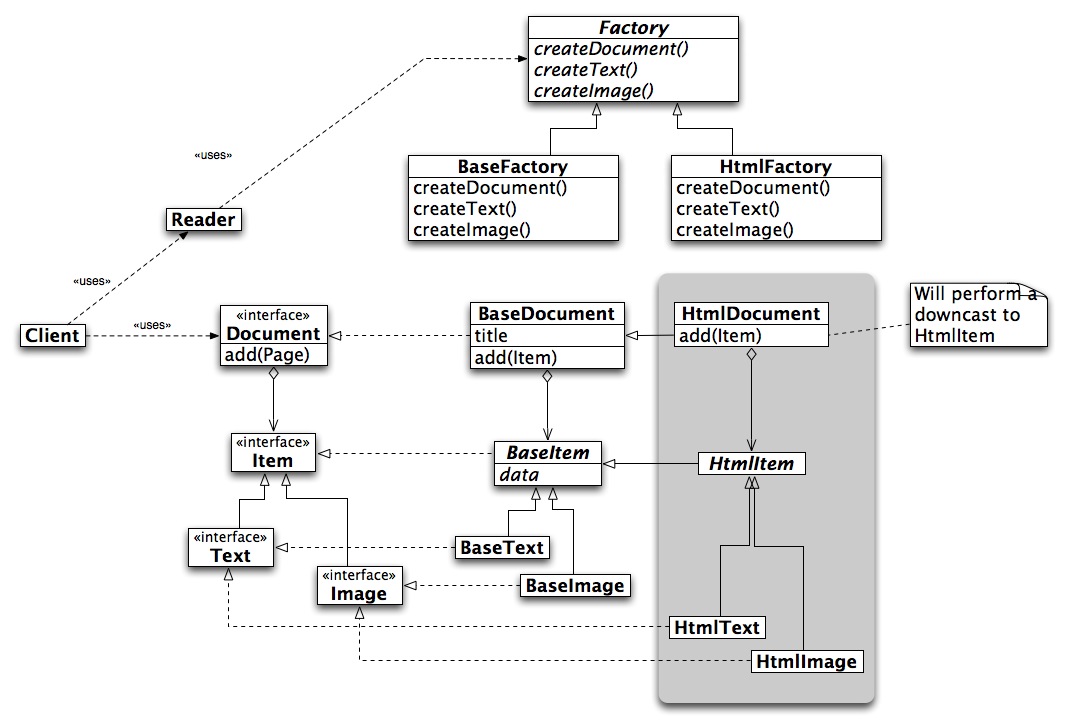
The two first problems can be circumvented with interfaces and factories. The third one might require a downcast in add(), if specialized classes have added methods. If only existing methods have been overriden, traditional polymorphism is enough.

Generics provide a partial solution to the problem. Document can accept a parameteric type <A extends Item>, so that HtmlDocument can be defined as an extension of Document<HtmlItem> (see this answer for an example). The downcast in method add() disappears. Item is however abstract, and the system assumes there are two implementations of it, Text and Image. With generics, the class Document can not create instances of these with regular instantiations new Text() or new Image(). First it would not comply necessary with the parametric type <A extends Item>, second, these instantiations would not be rewired correctly to their corresponding class in the other family. If classes were first-class, one could at least define abstract static factory methods createText() and createImage() in Item. This is however not  possible in Java, and static method can not be overriden, because classes are not first-class.

In a dynamicaly typed language, the usage of interface vanished, as well as the third issue. However, in both case problem (1) and (2) remain.

The lack of multiple inheritance in this case leads to code duplication between the classes for which not inheritance relationship exist. To avoid such code duplication, delegation could be used and an instance of HtmlText could delegate to an instance of BaseText. As pure delegation is not supported, this require writing boilerplate forwarding methods, which is still clusmy. Another way to avoid code duplication would be to factor the duplicated code into traits or mixin that can be reused among unrelated classes.

No matter what, this design is ugly–and it is really found in practice.

Revisiting the three problems

The  problems discussed before can be rephrased into three separated questions:

– How can the reader produce the right kind of document (either basic, or html) without invasive changes?

– How can variations of a class hierarchy be created with minimal efforts and no boilderplate code ?

– How can the type system be aware of logical relationship between types, e.g. HtmlDocument always goes with HtmlItem?

The fourth problem

One fourth problem not depicted but that happens in practice, is that two class hierarchy relate to each other, but in slightly incompatible ways. This typically happens due to software evolution, when method are renamed, signature are changed, etc. An example would be to change the “data” in Item from binary byte[]  to base64 string. While certain kinds of changes can be accomodated by providing convertion functions (they act as wrapper), this bloats the design and prevent clean evolution.  Sometimes it is impossible to create an inheritance relationship between the two variants of the classes, which  means that whole graphs must be adapted back and forth from one representation to the other. We state the fourth problem as follows:

– How can graph of objects be converted from one logical representation to another easily, whithout that the convertion logic bloats the code?

The fifth problem

One fifth problem not discussed so far is actually a requirement:

– How can the new families be introduced a posteriori, without entailing modification or invalidation of exisitng code.

This problem is usually referred to as modularity.

Language constructs

These problems are clearly related to each others, as is showed by the example.  A definitive solution to all three of them is to my knowledge still not available, but there has been progress in programming language to provide means to tackle part of them.

  • Design patterns (strategy, factory)
  • Generics
  • Static & dynamic reuse mechanisms (delegation, traits, talents)
  • Family polymorphism
  • Virtual classes (newspeak/gbeta, dependency injection, first-class class)
  • Object Algebras
  • Local rebinding (classbox)
  • Open classes
  • Multi-dimensional dispatch (subject-oriented programming, context-oriented programming, worlds, namespace selector)
  • Non-standard type coercion (translation polymorphism in Object Team & lifted Java, expander)
  • Type versioning (type hot swapping, upgradeJ, revision classes)

It seems to me there is room for something actually missing that would solve the problem depicted above–or myabe it exist but I am not aware of it?

Links

Ownership for Dynamic Languages

Edit: the idea presented in this post was worked out into a consistent language feature and accepted for publication.

Ownership type systems have been designed for statically typed languages to confine and constraint aliasing, which in turn increases security and safety. Ownership type systems are conservative, and can only enforce properties that are known to hold globally and statically.

Rather than taking a static view on ownership, a dynamic view would be more natural–and accurate–and could also be applied to dynamic languages. The pendent of static typing in dynamic languages is testing. Ownership violations would raise run-time errors. The system would need to be tested to ensure it is free of ownership violation. This bears resemblance with contracts, and ownership could be seen as special kind of run-time contracts. Also, similarly to contracts, once the system has been exhaustively tested, run-time ownership checks could be disabled.

The ownership relationship between objects could be changed at run-time. While we can expect that most of the time, the owner of an object remains the same and is known at object creation-time, this must not necessary be the case. Whether an object can have multiple owners or not is an open question. If we restrict the system to one owner per object, the syntax could be as simple as:

anObject := MyClass newOwn. "create a new instance that will be owned by self"
anObject := MyClass new ownedBy: anOwner. "assigned an arbitraty owner"

Of course, only an ower that satifies the ownership constraint can be assigned, not any object. Once assigned an owner, the system would enforce no aliasing happen that would violate the ownership constraint. In practice, this means that assignments, and parameter passing must be checked at run-time. This is not trivial without entailing a high overhead in space and time.

Combined with resumable exceptions, ownership violations might not be fatal, and could be considered as special events one can catch when objects escape their owners. For instance, when an object escapes its threads, it could be adapted to become thread-safe, or objects could be frozen (i.e. made read-only) when then escape their owner. An variant would be be able to specify a treatment block per ownership relationship, that would be executed if the constraint is broken. By default, objects would have flag that indicates if the contraints holds (for sure) or not. Raising exception or other strategies would be built on top of that.

MyClass new ownedBy: anOwner ifViolated: aBlock. "treatment if constraint is violated"
aFlag := anObject isOwnershipEnforced.

There are few interesting questions around this run-time perspective on ownership:

  • Can certains patterns be better expressed with ownership?
  • Does the ownership information help program understanding?
  • Do objects have one natural owner in practice?
  • Do run-time ownership checking help spot bugs or increase safety?
  • How can run-time ownership checking be made practical from point of view of performance?

Ah! As usual, more questions than answers…

Implementation of Semaphores

For the need of the experimental Pinocchio research VM, we needed to add support for threading and concurrency. We implemented green threads, a la Squeak and there is then no “real” multi-core concurrency going on. The VM relies on AST interpretation, instead of bytecode. With green threads, the interpretation of an AST node can always be considered atomic: no two AST node can be interpreted concurrently. This is unlike Java and its memory model, where individual bytecodes can be interpreted concurrently, possibly with nasty side-effects (e.g. manipulation of long is not atomic). Thread preemption can happen anytime between AST nodes evaluation.

How can we add support for semaphores?

The pharo design

The pharo design can be informally summarize like this: when a semaphore is instantiated, its counter is set to one. Whenever a block needs to be evaluated in an exclusive way, the counter is checked. If the counter > 0, it is decreased and the block is evaluated. If the counter = 0, the thread is suspended an added to the list of threads currently waiting on this semaphore. When the critical block has been evaluated, the list of suspended threads is checked. If there are not suspended threads, the counter is incremented to 1. Otherwise, one of the suspended thread is picked and resumed.

This implementation explains why Semaphore extends LinkedList. I’m not sure it’s the best design decision, because it’s not conceptually a list and the list protocol should not be exposed by a semaphore. It uses inheritance for implementation reuse, but composition would have been just fine here if the semaphore was internally holding a linked list (and maybe use a pluggable ownership type system to check that the list does not leak out of the semaphore…).

Also, semaphores must be created using the forMutualExclusion factory method. This method instantiates and initialize the semaphore to allow exactly one execution at a time (hence the term mutual exclusion), but nothing would prevent you from initializing the semaphore so that up to N blocks can be executed concurrently.

The respective code for wait and signal (which respectively decrement and increment the counter) are:

wait
 excessSignals>0
 ifTrue: [excessSignals := excessSignals-1]
 ifFalse: [self addLastLink: Processor activeProcess suspend]
signal
 self isEmpty
 ifTrue: [excessSignals := excessSignals+1]
 ifFalse: [Processor resume: self removeFirstLink]

They are however implemented as primitives. I suspect this is not for performance reason, but for the sake of concurrency correctness. These operation themselves need to be atomic. Implemented in Smalltalk, the thread could be preempted during one of these, breaking the semaphore’s design.

The test-and-set design

These two methods and the internal counter suggest that an implementation relying on more generic concurrency primitive is possible. Typical concurrency primitives for this are test-and-set or compare-and-swap.
 We’ve added a primitive testAndSet to Boolean, and implemented the Semphore with busy waiting (also sometimes called spin lock):
 
 critical: aBlock
 | v |
 "we spin on the lock until we can enter the semaphore"
 [ lock testAndSet ] whileTrue: [ PThread current yield ].
 "we evaluate the block and make sure we reset the flag when we leave it"
 [ v := aBlock value. ] ensure: [ lock value: false ].
 ^ v.

The design could be improved to no use busy waiting. Instead of yielding, the thread would be suspended and added to a list. In the ensure block,  the flag would be reset and one of the thread would be resumed. The resumed thread would however still need to testAndSet the lock to prevent that no other thread has entered the semaphore in the meantime, possibly delaying the thread forever. So if fairness is required, this algorithm is not optimal.

The bakery design

You can also implement critical section without the support of other concurrency primitives. The most famous one is probably Lamport’s bakery algorithm:

What is significant about the bakery algorithm is that it implements mutual exclusion without relying on any lower-level mutual exclusion.  Assuming that reads and writes of a memory location are atomic actions, as previous mutual exclusion algorithms had done, is tantamount to assuming mutually exclusive access to the location.  So a mutual exclusion algorithm that assumes atomic reads and writes is assuming lower-level mutual exclusion.  Such an algorithm cannot really be said to solve the mutual exclusion problem.  Before the bakery algorithm, people believed that the mutual exclusion problem was unsolvable–that you could implement mutual exclusion only by using lower-level mutual exclusion.

In our case with green threads, read and write are atomic because they are single AST nodes, but this isn’t necessary the case.

Here ends this little trip into basic concurrency. There is a rich litterature on the topic — which is truely fantastic — and we might explore and implement more sophisicated abstractions later on.

References

The Java Memory Model
Thread Synchronization and Critical Section Problem
A New Solution of Dijkstra’s Concurrent Programming Problem

Anti-if Programming

If are bad, if are evil. If are against object-oriented programming. If defeats polymorphism — These popular remarks are easier said than enforced.

Ifs can pop up for various reasons, which would deserve a full study in order to build a decent taxonomy. Here is however a quick one:

  • Algorithmic if. An algorithmic if participate in an algorithm that is inherently procedural, where branching is required. No much can be done for these ones. Though they tend to increase the cyclomatic complexity, they are not the most evil. If the algorithm is inherently complex, so be it.
  • Polymorphic if. A class of object deserve some slightly different treatment each time. This is the polymorphic if. Following object oriented principles, the treatment should be pushed in the corresponding class, and voila! There are however million of reasons why we don’t want the corresponding logic to be in the class of the object to treat, defeating object oriented basics. In such case, the problem can be alleviated with visitor, decorator, or other composition techniques.
  • Strategic if. A single class deals with N different situations. The logic is still essentially the same, but there are slight different in each situation. This situation can be refactored with an interface, and several implementations. The implementations can inherit from each other, or use delegation to maximize reuse.
  • Dynamic if. Strategic if assumes that the situation doesn’t change for the lifetime of the object. If the behavior of the object needs to change dynamically, the situation becomes even more complicated. Chances are that attributes will be used to enable/disable certain behavior at run-time. Such if can be refactored with patterns such as decorators.
  • Null if. Test for nullity is so common that it deserves a special category, even though it could be seen as a special case of another category.  Null if can happen to test the termination of an algorithm, the non-existence of data, sanity check, etc. Various techniques exist to eradict such if depending on the situation: Null Object pattern, add as many method signature as required, introducing polymorphism, usage of assertions, etc.

A step-by-step Anti-If refactoring

Here is a step-by-step refactoring of a strategic if I came accross . I plan to send it to the anti-If compaign and took then the time to document it. The code comes from the txfs project.

Let’s start with the original code:

public void writeFile (String destFileName, InputStream data, boolean overwrite)
throws TxfsException
{
FileOutputStream fos = null;
BufferedOutputStream bos = null;
boolean isNew = false;
File f = new File (infos.getPath (), destFileName);
if ( !overwrite && f.exists () )
{
throw new TxfsException ("Error writing in file (file already exist):" +
destFileName);
}

try
{
if ( !f.exists () )
{
isNew = true;
}
DirectoryUtil.mkDirs (f.getParentFile ());
try
{
Copier.copy (data, f);
}
finally
{
if ( isNew && isInTransaction () )
{
addCreatedFile (destFileName);
}
IOUtils.closeInputStream (data);
}
}
catch ( IOException e )
{
throw new TxfsException (“Error writing in file:” + destFileName, e);
}
}

Not very straightforward, isn’t it? The logic is however quite simple: if the overwrite flag is set, file can be written even if it already exists, otherwise an exception must be thrown. In addition to that, if a transaction is active, the file must be added to the list of created file, so that they can be removed in the transaction is rolled back later.  The file must be added even if an exception occurs, for instance if the file was partially copied.

What happens is that we have two concerns: (1) the overwrite rule and (2) the transaction rule.

Let’s try to refactor that with inheritance. A base class implements the logic when there is no transaction. And a subclass refines it to support transactions.

public void writeFile (String destFileName, InputStream data, boolean overwrite)
throws TxfsException
{
FileOutputStream fos = null;
BufferedOutputStream bos = null;
boolean isNew = false;
File f = new File (infos.getPath (), destFileName);
if ( !overwrite && f.exists () )
{
throw new TxfsException ("Error writing in file (file already exist):" +
destFileName);
}

try
{
// if ( !f.exists () )
// {
//    isNew = true;
// }
DirectoryUtil.mkDirs (f.getParentFile ());
try
{
Copier.copy (data, f);
}
finally
{
// if ( isNew && isInTransaction () )
// {
//     addCreatedFile (destFileName);
// }
IOUtils.closeInputStream (data);
}
}
catch ( IOException e )
{
throw new TxfsException (“Error writing in file:” + destFileName, e);
}
}

The transaction concern is removed from the base method. The overridden method looks then like:

public void writeFile (String destFileName, InputStream data, boolean overwrite)
throws TxfsException
{
try
{
super.writeFile( destFileName, data, overwrite );
}
finally
{
addCreatedFile (destFileName);
}
}

But we have then two problems: (1) we don’t know if the file is new, and it’s always added to the list of created file. (2) if the base method throw an exception because the file already exists and the flag is false, we still add it to the list of created file when we shouldn’t.

We could change the base method to have a return code (e.g. FileCreated and NoFileCreated). But return code are not generally a good solution and are quite ugly.

No, what we must do, is remove some responsibility to the method. We then split it into two methods createFile and writeFile. One expects the file to not exsits, the other the file to exists.

void writeFile (String dst, InputStream data ) throws TxfsException
void createFile (String dst, InputStream data ) throws TxfsException

(The method writeFile which takes the additional overwrite flag can be composed out of the two previous one )

So our simplified writeFile method looks like:

public void createFile(String destFileName, InputStream data)
throws TxfsException
{
try
{
super.createFile(destFileName, data);
}
finally
{
// we add the file in any case
addCreatedFile(destFileName);
}
}

Alas, there is still the problem that if super.writeFile fails because the file already exists, we add it to the list.

And here we start to realize that our exception handling scheme was a bit weak. The general TxfsException is rather useless: we need to refine the exception handling to convey sufficient information to support meaningful treatment.

void writeFile (String dst, InputStream data )
throws TxfsException, TxfsFileDoesNotExsistException

void createFile (String dst, InputStream data )
throws TxfsException, TxfsFileExistsAlreadyException

Here is then the final code:

public void createFile(String destFileName, InputStream data)
throws TxfsFileAlreadyExistsException, TxfsException
{
// I can not use a finally block because
// if failure happens because file already existed       

// I must not add it the list
try {
super.createFile(destFileName, data);
// we add the file if creation succeeds
addCreatedFile(destFileName);
}
catch (TxfsFileAlreadyExistsException e)
{
// we don't add the file if it already exists
throw e;
}
catch (Throwable e)
{
// we add the file in any other case
addCreatedFile(destFileName);
}
}
}

Conclusion

Anti-If refactoring is not so easy. There are various kind of ifs, some of which are ok, and some of which are bad. Removing ifs can imply changing the design significantly, including the inheritance hierarchy and the exception hierarchy.

A tool to analyze and propose refactoring suggestion would be cool, but for the time being, NoIF refactoring is probably in the hands of developers which can ensure the semantics equivalence of the code before and after the refactoring.

Links

http://www.technology-ebay.de/the-teams/mobile-de/blog/an-exercise-in-unconditional-programming.html

Object-Oriented Equality

I discussed in my previous post the fact that we need a better support of immutability in object-oriented language. The problem is that it’s no so easy to add because the object paradigm is rooted in the concept of an object being an entity whose state is normally mutable. I discuss here about one of its cousin: object equality.

Some objects are more equal than others

First a quick recap. Object equality is an equivalence relation traditionally implemented through equals and hashCode. Here is the corresponding Javadoc:

The equals method implements an equivalence relation on non-null object references:
•    It is reflexive: for any non-null reference value x, x.equals(x) should return true.
•    It is symmetric: for any non-null reference values x and y, x.equals(y) should return true if and only if y.equals(x) returns true.
•    It is transitive: for any non-null reference values x, y, and z, if x.equals(y) returns true and y.equals(z) returns true, then x.equals(z) should return true.
•    It is consistent: for any non-null reference values x and y, multiple invocations of x.equals(y) consistently return true or consistently return false, provided no information used in equals comparisons on the objects is modified.
•    For any non-null reference value x, x.equals(null) should return false.

The definition implicitly allows mutable state to be used for equality. This is however dangerous, and equals should be defined only based on immutable state when possible.

This is notably a requirement for Collections, which require a stronger equality contract. If the object equality changes while it is in the collection, the behavior of the collection may not be consistent. See pitfall #3 in How to write equality in Java.

The simplest solution to this problem is to make object equality immutable, that is, the fields participating in the equivalence relation are final – the equality can never change post-construction.

This is however not always possible, especially if the object requires an initialization in a post-construction phase. If the object equality depends on related objects, a strictly immutable object might still see its hashCode change if one of the depending object is mutated. This leads to the concept of ownership, where object that are owned should also be immutable. Pure ownership is however an object-level/run-time concern which is not easy to ensure (class-based ownership is possible but more limited).

As presented in “Understanding the Impact of Collection Contracts on Design”, we should then consider (i) the construction of object (ii) the mutability of the object state and (iii) the “deepness” of the equivalence relationship to reason about object equality.

We have then actually three types of fields:

–    final. Never change post-construction and referenced object is immutable
–    eventually final. Can change post-construction but will be frozen in a point in time
–    mutable. Can be mutated anytime.

Object could be frozen post-creation as is proposed in “Flexible immutability with frozen objects”. The equivalence relation could use only final and eventually final fields. Owned object could be modified only through the parent object, as to ensure that the equality contract is never broken.

There is no one notion of equivalence

The problem remains that there is not “correct” implementation of object equality. It mostly depends on the usage. You may want to compare list based on reference identity, but also based on their content sometimes. Should we then have a notion of  “deepness” right into the equals operator, in a way similar to the variants of shallow and deep cloning?

aList.deepEquals( anotherList )

Well, that’s actually what already exists with OrderedCollection, where you specify the Comparator to be used. Is it the solution? Should we remove the object equality form the object and move it the client of the object?

Set s = new HashSet( new ReferenceEqualityContract() );

Or should we be able to instantiate an object and specify which equality contract (or more generally a comparison contract) it should fulfill?

In this case, an object is limited to have only one equivalence relation at a time.  (See this post for a Haskell sample of how to do it)

One could specify the behavior of the object at creation time and see that as an object-level behavioral variation. The types of two objects with different equivalence relation should however be different to ensure the relation is always symmetric (objects with different equivalence relation are always different). This means that the each specific variation would correspond to a type, which inherits from a common type.

– Is object equality as subset of the problem of object comparison? Or are they fundamentally different? State used for comparison shouldn’t change while object is in collection, but it’s no necessary part of the “primary key”…

– Should an object have only one equivalence or comparison definition at a time? Or could an object have several ones at the same time? Or one equivalence relation but several comparison definitions at a time? (We could easily imagine two lists with the same objects, but one list storing the object in ascending order and the other one in descending order)

The fact is that in a pure object world we should uniquely compare object by reference. There should be no two objects with the same “primary key”. In “Declarative object identity using relation type“, the authors introduced the notion of scope as to create and obtain the same reference for a given key. The risk then is to alter objects in an unexpected way and break other object invariants (dangling alias, etc.). It is simply impractical. The world is constantly evolving, and we are forces sometimes to have two objects for the same entity: one for the old and one for the new entity (See this other post on persistent data structure). Such objects somehow relates together and are not completely “different”, hence the notion of object equality.

But this little digression still doesn’t solve the issue that whatever the equality contract that the object must fulfill, we cannot ensure that it will be the case.

And it gets worse with inheritance

“There is no way to extend an instantiable class and add a value component while preserving the equals contract, unless you are willing to forgo the benefits of object-oriented abstraction.”  — Effective Java

Indeed if we have a Point class and a ColorPoint class, the equivalence relation may be broken if ColorPoint doesn’t redefine equals and hashCode. See pitfall #4 in How to write equality in Java. To enforce the equality contract, two objects may be equal only if they have the same type.

The problem is that it is too restrictive. A context that uses color points, such as a graphic editor, may want to share the points with a context that doesn’t have a notion of color, such as 2D algorithm.  The graphic editor would test the equivalence of two figures according to the color as well. And the 2D algorithm would test the equivalence of two points according to their position solely, in a way to prevent division by zero.

Also, once an object has overridden the default equals and hashCode which implements reference equality, it is also impossible for an object to fall back to this mode. As a consequence we may end up in a situation with subclasses whose equivalence relation can’t be expressed. In such case, it should be forbidden to compare objects.

Should we then re-think object equality with ternary logic, so as to be able to return true, false and N/A?

EDIT

Here I will gather other links related to the subjects

Object-Oriented Immutability

There seem to be a growing awareness about the benefit of immutability. Particular cases where immutable objects are much welcome are for instance in the case of value objects or for defensive copying. The problem is that immutable object don’t really go well with the object paradigm.

Let’s consider an application, which need to deal with the concept of revision. A revision is composed of a major and a minor revision number, e.g. “1.4”. This is typical candidate for a value object. The only sensible methods that deal with revision are inc which increases it, and promote which jumps to the next major version (“1.3” -> “2.0”). I will consider only inc in this post.

Here would be the (trivial) code in Java:

public class Revision
{
   private final int major;
   private final int minor;
   public Revision( int major, int minor ) { ... }

   public Revision inc() {
       return new Revision( major, minor+1 );
   }
}

This is however only a ad-hoc solution. This does not work well with polymorphism for instance: if a subclass of Revision is created, say NameRevision, calling inc on an instance would result in a Revision not NameRevision. This problem can be solved in other ways, and would for instance not appear in Smalltalk where instanciation would be done with super.basicNew on the class-side. But this just shows how mainstream OO language are not designed for immutability.

How would that be in a functional language such as Clojure? A map would probably be used to hold the major and minor number and the inc function would be as simple as setting a new value to the minor key in the map. Because any data modification results in a new structure, we don’t have the explicity make a difference between creating and modifying a structure. See my discussion on persitente data structure

(defn create-revision [] (hash-map :minor 1 :major 0))
(defn inc-revision [r] (assoc r :minor ( + (get r :minor) 1 ))

Note that the inc function is “polymorphic” in the sense that if I pass a map with :minor, :major and :name, I obtain a copy which has the three keys values.

The fundamental mismatch between OO and functional programming is that assignment has different semantics. In OO, assignment change the data in-place. In functional programming, assignments result in a copy.

And what if assignment would also result in a copy in OO? That sounds a bit contradictory to the OO spirit, but well, let’s give it a try…

If assignments result in a copy, this means that something like this.field = “newvalue” actually returns a new instance of the object, right? We could then imagine a class like this:

public class immutable Revision
{
   int major;
   int minor;

   public int getMajor {
      return this.major
   }

   public Revision setMajor( int value ) {
      // assignment result in a copy!
      return ( this.major = value );
   }

   // same for minor

   public Revision inc()  {
      return this.setMajor( this.getMinor() + 1 );
   }
}

We can somehow see that a generalized form of the builder pattern, and it fit well with fluent interface:

Revision r = new Revision( 1, 0 );
r.inc(); // return 1,1

But

Revision r =
new Revision( 1, 0 )
.inc()
.inc(); // return 1,2

Note the keyword immutable that is necessary to specify the semantics of assignment for the class (there will indeed always be some mutable classes).

We now have two semantics for the assignment, one producing a copy and one changing the data in-place.

That sounds logical, that all classes in class hierarchy share the same mutability.  Assigning a field from a subclass or a superclass should indeed produce the same result. But at the same time, this also means that we have two Object types? One mutable and one immutable? Hmm…

Another sound restriction for such a language would be to have assignment restricted to this. Something like obj.field = "newvalue" would be forbidden. This is anyway a good practice.

Also assuming that the language supports closures, do they fit in the picture? I would say yes, but I’m not sure. Given the signature of the closure is determined (it’s a function after all), and it cannot access any field of the object directly, so the semantics should be consistent.  This would however require a bit more formalization to ensure there is no hole…

Like in some other post, I don’t know if the idea presented here hold for real. But I do like immutable object even in OO, and think that OO language lacks supports for such design. Current solution for immutable object is ad-hoc, but we could imagine blending functional programming and OO a bit more, resulting in some object having a hybrid behavior. Such object would essentially be immutable data structure embedding at the same time the function that corresponds to them, which still fit the equation Object = Data + Logic.

More About Immutability

  • To mutate or not to mutate?
  • Frozen object in ruby
  • Java.next : immutability “But the benefit of using immutable data increases when you compose objects together. If you wanted to compose the synchronized version with another object, you would have have to dig back into the internals of both objects, study their locks, and pick a new lock strategy to cover the two objects together. Composing operations with immutable objects is much easier.”

11 Reasons Why I Hate XML

… at least in Java.

1 – Namespace and import

XML is only apparently simple. As soon as namespace are used, it immediately gets complicated.  What is the difference between targetNamespace=”…”, xmlns=”…” and xmlns:tns=”…” ? Can I declare several prefixes for the same namespace? Can I change the default namespace from within a document? What happens if I import a schema and rebind it to another namespace? How do I reference an element unambiguously? Ever wondered how to really create a QName correctly? Ever wondered what happens if you have a cycle in your dependencies?

2 – Encoding and CDATA

XML encoding and file encoding are not the same.  This is a huge source of troubles. Both encoding must match, and the XML file should be read and parsed according to the encoding specified in the XML header. Depending on the encoding, characters will be serialized in a different way, again a huge source of confusion. If the reader or writer of an XML document behave incorrectly, the document can be dangerously corrupted and information can be lost. Editors don’t necessary display the characters correctly, while the document may be right. Ever got a ? or ¿ in your text? Ever made a distinction between &amp; and & ? Ever wondered whether a CDATA section was necessary or if using UTF-8 would be ok? Ever realized that < and > can be used as-is in attributes but need an encoding within a tag?

3 – Entities and DOCTYPE

Somehow relates to #2, but not only. XML entities are a generic way to define variables and are declared in the DOCTYPE. You can define custom entities; this is rather unusual but still need to be supported. Entites can be internal or external to your XML document, in which case the entity resolving might differ. Because entities are also used to escape special character, you can not consider this as an advanced feature that you won’t use. XML entities needs to be handled with care and is always a source of trouble. For instance, the tag <my-tag>hello&amp;world</my-tag> will trigger 3 characters(...) events with SAX.

4 – Naming convention

Ever wondered whether it was actually better to name your tag <my-tag/>, <myTag/> or <MyTag/>? The same goes for attributes….

5 Null, empty string and white spaces

Making the difference between null and empty string with XML is always painful. Null would be represented by the absence of the tag or attribute, whereas empty string would be represented with an empty tag or empty attribute. The same problem appears if you want to distinguish empty list and no list at all. If not considered clearly upfront (which is frequently the case), it can be very hard to retrofit clearly this distinction in an application.
Whitespace is another issue on its own. The way tabs, spaces, carriage return, line feeds are processed is always confusing. There are some options to control that, but it’s way too complicated for most of the usage. As a consequence, sometimes these special characters will be encoding in entities, sometimes embedded in CDATA and sometimes stores as-is in the XML.

6 – Normalization

XML encryption and signature look fine on paper. But as soon as you dig in the spec, you realize that it’s not so easy because of the syntactic and semantic equivalence of XML document. Is <my-tag></my-tag> the same as <my-tag/>? To solve this issue, XML normalization was introduced which define the canonical representation of a document. Good luck to understand all the subtleties when considering remarks #1, #2,  #3 and #5.

7 – Too many API and implementations

Even if stuffs improved in this area, there are too many API and implementation available. I wish there was one unified API and one single implementation sometimes…Ever wondered how to select a specific implementation?  Ever got a classloader issue due to an XML library? Ever got confused whether StAX was actually really better than SAX to read XML documents?

8 – Implementation options

Most XML implementations have options or features to deal with the subtleties I just describe. This is especially true for namespace handling. As a consequence, you code may work on one implementation but not on another.  For instance, startDocument should be used to start an XML document and deal with namespace correctly. The strictness of the implementations differs, so don’t take for granted that portability is 100%.

9 – Pretty printing

There are so many API and frameworks that it’s always a mess to deal with pretty printing, if supported by the framework.

10 – Security

XML was not designed for security. Notorious problems are: dangerous framework extension, XML bomb, outbound connection to access remote schema, extensive memory consumption, and many more problems documented in this excellent article from MISC. As a consequence, XML document can be easily abused to disrupt the system.

11 – XPath and XSLT

XPath and XSLT belong to the XML ecosystem and suffer the same problems as XML itself: apparent simplicity but internal complexity. I won’t speak here about everything else that surrounds XML and that forms the big picture of the XML family specifications. I will just say that I recently got a NPE in NetBeans because “/wsa:MessageID” was not ok but using “/wsa:MessageID/.” was just fine.  Got the point?

OpenESB: Invoke an Asynchronous Web Service

I was contacted last week to know if I had actually integrated an asynchronous web service in OpenESB, as promised in a previous post. The NetBeans SOA package is sometimes a bit obscure, though there are some explanation about the examples. I took a bit of time to dig this out, and here is then the promised follow-up (except that I won’t use WS-Addressing). I will use

  • OpenESB bundled with Glassfish
  • NetBeans to author the BPEL process
  • SoapUI to test the process

What we want to get

The BPEL process that will be created is a synchronous BPEL process, which calls an asynchronous web service using a correlation set to “resume” the process when the asynchronous response is received. The scenario is not very realistic – a BPEL process that calls an asynchronous WS will itself be asynchronous most of the time. The asynchronous WS may indeed take arbitrary long to respond; the client of the BPEL process would probably time out in this case.  This example suffices however to show the underlying principles.

  • The BPEL process is synchronous
  • But it calls an asynchronous WS service
  • We use correlation-set for request/response matching

The BPEL process that we want to obtain at the end is shown below:

Create the PartnerLinks

One or two PartnerLinks?

Communication to and from the asynchronous web service can be realized using a single partner link with two ports or using two partner links with one port each.
From point of view of BPEL an asynchronous request/response is indeed no more than a pair of one-way messages. The request/response matching will anyway be done using correlation set.

As a consequence, the messages can come from “anywhere” and there is therefore not need to have one single partner link. I found it easier to have 2 partner links so that all ports on the left side are the one exposed by the process, and all ports on the right side are the one consumed by the process.

WSDL with one-way PartnerLink

PartnerLinks can be defined in the BPEL process or in the WSDL of the web service. NetBeans has a nice feature to create the PartnerLink in a WSDL therefore I chose to define them there.

A one-way web service is a web service which defines only <input> or <output>. I therefore took the WSDL of my previous post and simply removed the <output> tags so that they become one-way web service. (I also removed anything related to WS-Addressing as it’s not used here).

The PartnerLink can then easily be created with NetBeans using the “Partner” view in the WSDL. The two WSDLs then looked like this:


Create the BPEL process

Add the PartnerLink

Now that the WSDL files of the asynchronous web services are ready, I create a new BPEL process. I then added the following PartnerLinks:

  • AsynchronousSampleClient from the SOA sample bundled with NetBeans
  • AsyncTestImplService created previously
  • AsyncTestResponseImplService create previously

Wire the request/response

Then I wired the request/response as follows. I relied on NetBeans variable creation for each <invoke> or <receive> activity. I therefore got the following variables:

  • ResponseIn
  • SayHelloIn
  • OperationAIn
  • OperationAOut

Assign the variables

For the purpose of this example I assign the variable between the message like follows. Note that this example make no sense from a business point of view.


Define the correlation set

A receive activity within the process should be assigned a correlation set. The BPEL engine is otherwise unable to match the request/response and resume the right process instance.

I defined a correlation set “correlation” which would use the property “correlationProp”.  A correlation property is a value that existing in different message and that can be used to match messages together. The property itself is a “symbolic” name for the value, and the corresponding element in each message is defined using so-called property aliases.
I then added two aliases, one in each WSDL file, and defined how “correlationProp” would map in the “sayHello” and “response” message respectively.

The process can then be built without warnings.

Deployment

The endpoint ports

The process defines 3 ports that can be changed according to your need. In this example the expected endpoints are:

The corresponding WSDL can be obtain by appending  “?wsdl” in the URL.

Note that the address for the asynchronous callback is not passed as parameter from the BPEL process, but should be hard-coded in the web service implementation. It would however be very easy to pass the callback address as an extra parameter so that the asynchronous web service is entirely decoupled of the BPEL process.

Build

Rebuild the process to take the latest change in the port URL.

Create the composite application (CA)

The BPEL process cannot be deployed as-is. You will need to embed the BPEL process into a composite application, which is a deployable unit. This is very easy to do:

  1. Create a new project of type composite application.
  2. Drag and drop the BPEL project onto the Service Assembly
  3. Rebuild the composite application

All that is necessary will be created automatically during the build. After the build is complete, NetBeans will refresh the Service Assembly and it looks then like this:

Deploy

Go in the Glassfish console and deploy the service assembly produced in the previous step.

Import WSDL in SoapUI

Start SoapUI and import the 3 WSDL.

Mock the asynchronous web service

Now that the 3 WSDL have been imported, we will create a mock for the asynchronous web service.  This way we can verify if the BPEL process call the asynchronous web service correctly and we can send the callback response manually.

Select the WSDL “AsyncTestImplPortBinding”,  and right-click “Generate Mock Service”. Make sure to use

  • path = /AsyncTestImplService/AsyncTestImpl?*
  • port = 8888

So that it matches the port that the BPEL process will use.

Make sure to start the Mock, in which case SaopUI displays “running on port 8888” at the top-right of the Mock window. The project looks like this:

Test

1 – Invoke BPEL process

Send the following SOAP message to the BPEL process (located at http://localhost:18182/AsynchronousSampleClient):

<soapenv:Envelope xmlns:soapenv="http://schemas.xmlsoap.org/soap/envelope/"

xmlns:asy="http://enterprise.netbeans.org/bpel/AsynchronousSampleSchemaNamespace">
<soapenv:Header/>
<soapenv:Body>
<asy:typeA>
<paramA>dummy</paramA>
<id>123</id>
</asy:typeA>
</soapenv:Body>
</soapenv:Envelope>

2 – Receive the asynchronous invocation

When the Mock service the asynchronous message it displays something like “[sayHello] 4ms”. The message can be opened and should look like:

<SOAP-ENV:Envelope xmlns:SOAP-ENV="http://schemas.xmlsoap.org/soap/envelope/">
<SOAP-ENV:Body>
<sayHello xmlns:msgns="http://ewe.org/" xmlns="http://ewe.org/">
<arg0 xmlns="">123</arg0>
</sayHello>
</SOAP-ENV:Body>
</SOAP-ENV:Envelope>

3 – Send the callback manually

We simulate manually the behavior of the mock service and send the following message to the callback endpoint (http://localhost:18182/AsynchronousSampleClient/response):

<soapenv:Envelope xmlns:soapenv="http://schemas.xmlsoap.org/soap/envelope/"
xmlns:ewe="http://ewe.org/">
<soapenv:Header/>
<soapenv:Body>
<ewe:response>
<!--Optional:-->
<arg0>123</arg0>
</ewe:response>
</soapenv:Body>
</soapenv:Envelope>

4 – Get the synchronous reply

So far, the SOAP request of step #1 was still waiting to receive the synchronous response.  After the callback has been sent, the BPEL engine should resume the right instance of the BPEL process (using the correlation value “123”), which should then terminate.

SoapUI will display the time taken for the request/response which will then be something like “response time: 5734 ms”. The time will of course depend on how long you took to perform step 2 and 3. (Note that after some time, the request will timeout if you really take too long to do these steps.)
The SOAP response message should look like:

<SOAP-ENV:Envelope xmlns:SOAP-ENV="http://schemas.xmlsoap.org/soap/envelope/">
<SOAP-ENV:Body>
<typeA
xmlns:msgns="http://enterprise.netbeans.org/bpel/AsynchronousSampleClient"
xmlns="http://enterprise.netbeans.org/bpel/AsynchronousSampleSchemaNamespace">
<id xmlns="">123</id>
</typeA>
</SOAP-ENV:Body>
</SOAP-ENV:Envelope>

Conclusion

This example as-is make little sense from a technical and business point of view; I wish I had also used more meaningul names for the various elements. It however shows the principle of asynchronous web service invocation using OpenESB. The adaption of this example for meaningful use cases should be relatively simple. It’s a matter of changing the message types and assignment rules.