I was pleasently surprised to see Systems Thinking as principle #2 in SAFe. I recently came in contact with systems thinking when reading Limits to Growth, which explores the feedack loops in the global economy. Donella Meadows is also the author of Thinking in Systems, which addresses more generally how to understand complex systems dynamics with such feedback loops (the book is in my list of to-read).
This is the definiton of systems thinking according to SAFe:
Systems thinking takes a holistic approach to solution development, incorporating all aspects of a system and its environment into the design, development, deployment, and maintenance of the system itself.
It’s quite general. But arguably, there isn’t one definiton of systems thinking. If you read Tools for Systems Thinker, the study of feedback loops is only one aspect of systems thinking. The more general theme is to understand the “interconntedness” of the elements in the system.
A system is a set of releated components that work together in a particular environment to perform watherver funtions are required to achieve the system’s objective. – Donella Meadows
Principle #2 in SAFe is about realizing that the solution, but also the organisation, are complex systems that benefit from systems thinking.
Interestingly, Large Scale Scrum (LeSS) also has systems thinking as principle. It’s more concrete than the equivalent principle in SAFe. The emphasis is on seeing system dynamics, espectially with causal loop diagrams. The article is a very good introduction to such diagram. Here’s an exmaple of a very simple causal loop diagram:
I like the emphasis on actively visualizing system dynamic:
The practical aspect of this tip (NB: visualizing) is more important than may first be appreciated. It is vague and low-impact to suggest “be a systems thinker.” But if you and four colleagues get into the habit of standing together at a large whiteboard, sketching causal loop diagrams together, then there is a concrete and potentially high-impact practice that connects “be a systems thinker” with “do systems thinking.”
The idea is that it’s only when you start visualizing the systems dynamics that you also start understanding the mental models that people have, and only then can you start discussing about improvements.
I like the more concrete way to address system thinking in LeSS as in SAFe. Recently, I discussed with our RTE about some cultural issue related to knowhow sharing. Using a causal loop diagram would have been a very good vehicule to brainstom about the problem. I think I will borrow the tip from LeSS and start sketching such diagrams during conversations.
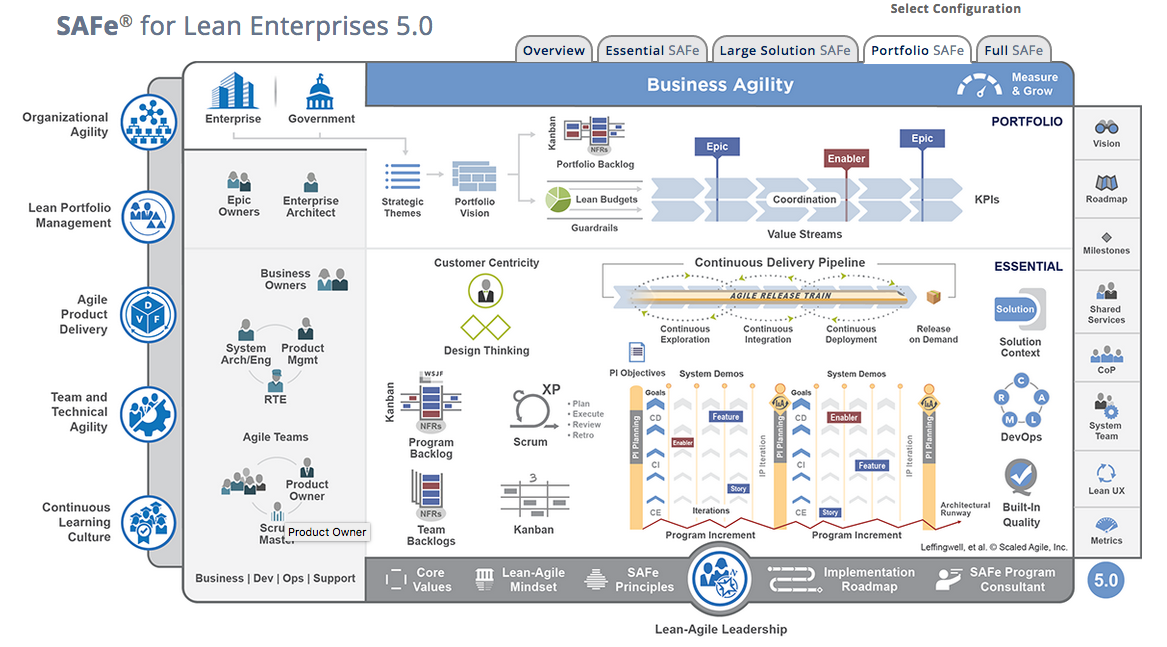
The Scaled Agile Framework (SAFe) is a complex framework. I mean, just look at this picture:
Long is gone the simplicity of Scrum. Its glossary contains 102 items (I counted them!), ranging from obvious concepts like a “story” to esoteric notions like “set-based design” with “customer centricity“ in between. The framework is meant to impose some structure, but at the same time, it has so many elements that with some creativity, you can probably retrofit any organisation in it without changing anything (for instance by abusing the concept of shared services). If agile was meant to be about simplicity, then SAFe is far from it.
SAFe comes in various “configurations”. The picture above is “portfolio” SAFe. And mind you, there is a “full” SAFe configuration which is even more complicated. But the core of SAFe – the “essential” configuration – has actually good parts:
ARTs should align with value streams. You organise you company in ARTs based on how you generate value to your customers so that each ART focuses on one part of the value stream. The definition of value streams is of course complicated in the glossary, with development and operational value streams distinct from each others, but the idea is actually good. You align IT and Business this way.
At the ART level, the leadership is split across three roles: Product Management, System Architecture, Release Train Engineer. I think that this split is a nice point in SAFe. It creates some balance in responsability and makes it clear the to be efficient, you need to address product features, architecture, and work culture together since they all impact each others.
SAFe also introduces a special terminology for things that aren’t features on their own: enablers. Chances are, you had this kind of work item already, just with a different name. But naming matters, and SAFe make a good use of the concept of “enabling” at various level. I like it.
The System Team helps with toolchains, infrastructure, build pipelines, integration testing.
Most companies develop their own organisation when growing, which will have some similar elements. Maybe you have different roles (e.g. “engineering managers”), or different ways to synchronize, or some other way to manage architectural work. Some things are surely different, but some things are probably similar, but named differently, or implemented differently. If you want to move to SAFe, how much you will need to adapt will depend. But for most enterprise, the change isn’t radical.
In this sense, SAFe is as collection of patterns. What SAFe gives you is a standard frame of reference to discuss about these aspects. SAFe establishes a common vocabulary to talk about the organisation and how to improve it. Where this analogy with patterns fails, though, is that you usually can decide to implement some pattern individually. SAFe come as a framework of patterns, where all of them must be implemented.
The „large solution“ configuration adds an additional level of scale with product management, train engineer, and architecture at the solution level. Solution and ARTs have the same cadence and synchronize through the same PI plannings. They have the same program backlog. This makes sense. (Historical note: “Program Level“ was replaced with “Essential” in SAFe 5, but the rest of the “program” terminology survived)
With the “portfolio” configuration, you have an additional level of “lean portfolio management” (LPM) whose goal is to « align strategy, funding and execution ». This adds epic owners, enterprise architects, lean business cases, KPI and the like the framework. According to the framework, only with this configuration can you achieve business agility. Something I like with SAFe is that idea to fund value streams rather than projects.
I understand that this level may match well with existing organizations, with funding systems and steering boards. But the portfolio level still has a bit the feeling of ARTs and Solution Trains as “factories”, divorced from real business accountability. If the goal is to bring IT and business closer to each other, why not push these elements to the ARTs and Solutions? Make them accountable for the value their products generate. In a way, I wished that this level wouldn’t exist, or existed in another form – for instance not beeing an addtional level but rather a vertical that complement the existing levels. I understand that some initiatives will impact several steps in the value stream, and thus possibly several ARTs or Solutions. But I hope it’s the exception, not the norm. On the other hand, maybe that’s also precisely the point of the portofolio level beeing above the Solution / ARTs. If your business (and thus value streams) isn’t yet clearly establisehd, you need another level to be able to shape the value streams based on feedback from the market. I think that the portfolio level will be used very differently from enterprise to enterprise.
In its core values, SAFe recognizes its influences: Agile development, Lean product development, systems thinking, and DevOps. The framework actively tries to combine these influences into a consistent whole. The problem is that it feels sometimes a bit too much: The SAFe core values page lists 4 values. The lean-agile mindset page lists 4 pillars. The SAFe lean-agile principles page lists 10 principles. The lean-agile leadership lists 3 dimensions. Business agility lists 7 competencies that are required (on the left in the picture, but “competency” isn’t in the glossary). I like conceptual frameworks, really. But it’s hard for me to not get lost here.
I guess that companies moving to SAFe will still need to tailor it to their needs anyway. Where I’m working, they added „subject-matter expect“, for instance. That’s fully in the idea of agility- tailor processes when you need it. But with this idea in mind, SAFe could have been kept smaller rather rather than trying to be all encompassing.


 Relentlessly Digital