It’s very interesting to see how SAFe evolved over the years. The version 2, circa 2013, looked like this:

Some things are worth noting:
- There is no large solution. Only Team/Program/Portfolio
- At the program, we find release management.
- The symmetry between PO/Team/ScrumMaster and PM/Arch/RTE isn’t yet established
- Spikes and Refactors, a terminology comming from eXtreme Programming
- Epics are primarily characterized as something that spans releases, to be broken down into features that fit in releases
Interestingly, this setup is very like the structure I know from my work.
This is version 3, circa 2014:

There aren’t that many changes compared to v2. The biggest change seems to be the introduction of value streams at the portfolio level. With it comes the ideas that we fund value streams. We also see some “principles” appear, like the House of Lean, the Lean-Agile Leadership, Built-In Quality at the Team Level.
Here is version 4, circa 2016:
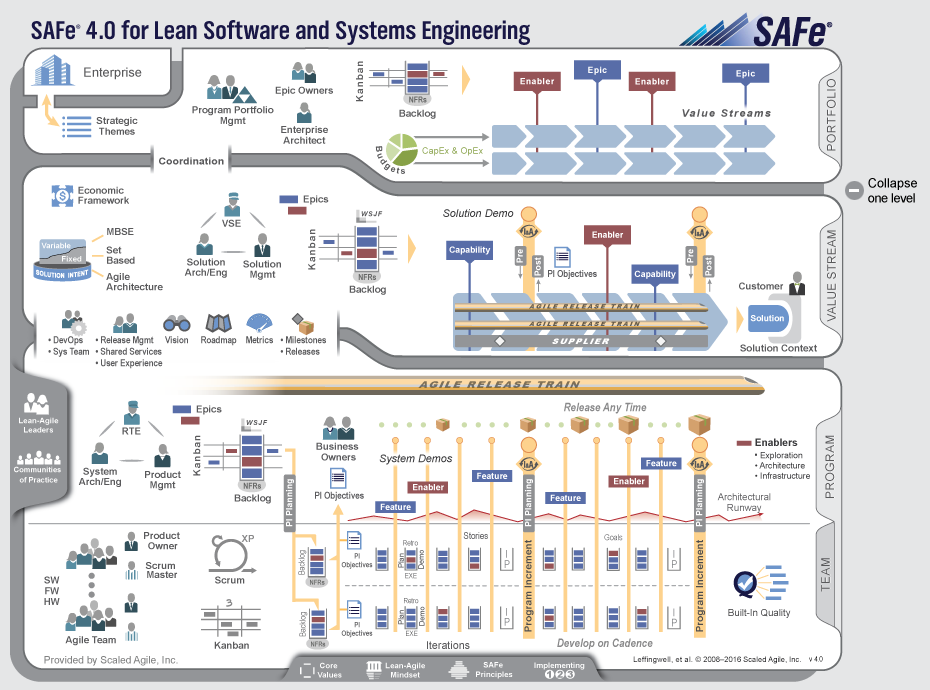
Major changes include:
- An additional level between program and portfolio: the value stream. The “Solution Train Engineering” from version 5 is a “Value Stream Engineer”. The value stream is very present in this configuration.
- The symmetry between PO/Team/SM – PM/Arch/RTE – SolMgmt/Arch/VSE is established
- Release management is subsumed with shared services
- Community of Practices appears
- Some additional “principles”: Economic Framework, MBSE, Set-based, Agile Architecture, Core Values, Lean-Agile Mindset, SAFe Principles.
Here’s version 4.5, circa 2018
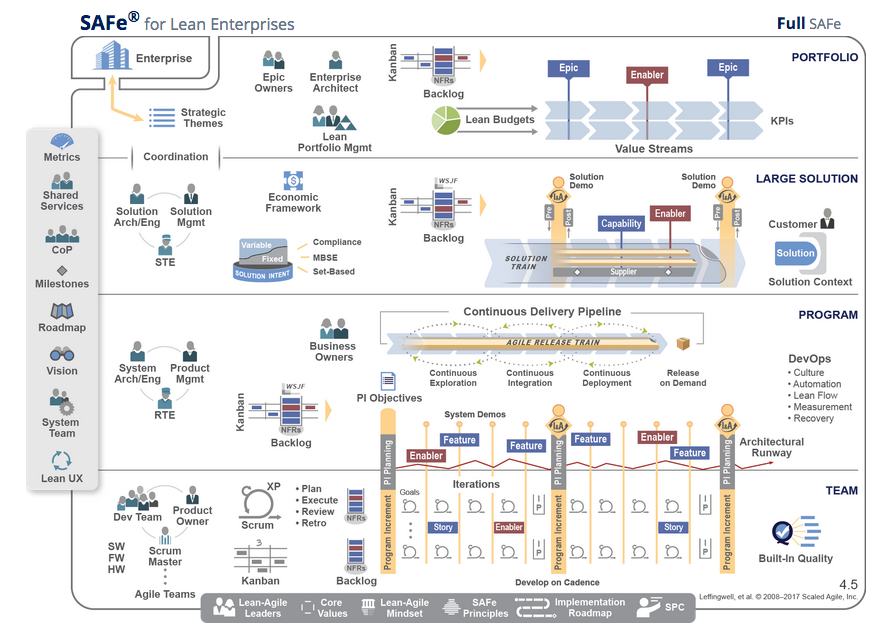
- Value Stream Level is replaced with Large Solution Level. With it the Value Stream Engineer becomes a Solution Train Engineer.
- Supporting artefacts and teams regroupped in a sidebar.
Here is the current version 5.1:

We have several major changes (here’s an detailed analysis of them)
- The introduction of “Business Agility” as the overarching goal, to be achieved with the profolio level.
- Introduction of the 7 core competencies (Organizational Agility, etc.)
- The levels Program and Team merge into “Essential”.
- Some more “principles”: customer-centricity, design thinking.
By studying the evolution of the framework I understand some things better now.
- The core of the framework with agile release train and portfolio levels remained quite stable over the years
- The large-solution level appeared over time, morphing from the value-stream level. The symmetry between the ART and solution level with the 3 roles PM/Arch/RTE took some time to evolve to how it is now.
- The term epic became more complicated to understand. It started as “something bigger than a release” and existed only at the porfolio level. In SAFe 5, epics can occur at all levels.
- Supporting artefacts and teams evolved over time, but these were much minor changes. The biggest change was probably the “subsumption” of release management in the shared services.
- Principles have generously been added continously to the framework. There are now a lot of them.
Just with anything that evolved, some inconsistencies accumulate. I find it interesting to observe this in domains other than code and architecture. For instance, in SAFe 5 the term “program” is still in use (Program Increment, Program Backlog), but the program level disappeared. This is due to historic reasons. Starting directly with the version 5, you would probably name things differently (e.g. “Solution Increment”). Also just like with code and architecture, the framework suffers from feature creep.
Somehow I’m a bit sad that they decided to go away with the “value stream level”. The idea of value stream is very powerful and putting in at center stage was nice. The version 4 has another spin as version 4.5. from an engineering standpoint. With the “value stream level”, various programs deliver independent products that together realize a value stream. With the terminology “large solution” of version 4.5, you get the impression that you have one “large solution” broken down in several components deliverd by various ARTs, that need to be integrated together. The difference can seem subtile, but I prefer the spin of version 4. The “large solution” terminology will tend towards centralization more than the “value stream” terminology.
As for the principles, there are simply too many of them. I believe that the signal-to-noise-ratio here is too high.
Introducing business agility is an interesting move from SAFe. I expect the discussion “development agility “ vs “business agility “ to be all the rage in the coming years. We know how to do agile development. But we still don’t get the expected outcome at the business level. The link is somehow not that trivial as in theory. Version 5 recognizes this and makes it clear that agile development is a mean to an end, not the end itself. It reminds us why we’re making all this. Here’s there’s a clear signal without noise, and it’s valuable.


 ://ewernli