Using Technology as Intended

Technology people come in two flavours: generalist and experts. I’m definitively a generalist. I’ve a good grasp of the core concepts being the technologies we use. I’m however lacking the expertise about the details of using them. For this, I rely on experts.

This lack of expertise of the details may even turn out to be an advantage in my position. Technologies have core concepts that support some primary technology use case. With enough knowledge about technical details, it’s possible to use the technology to support other use cases. But it’s almost never a good idea in the long term. The implementation will be fragile to subtle changes in details of the technology, and few people in the organization have enough expertise to maintain such an implementation. If your use case is not supported easily, rethink your problem at some other level. Not knowing too much about the technology means I’m limiting its use to what’s maintainable.

The last example of this kind that I encountered was about container dependencies on openshift. In our current system (not openshift-based), we start the containers using “run levels”. Such a concept doesn’t exist in openshift. You could recreate something similar using init containers and some deep technical knowledge, but it wouldn’t be trivial. Rather than misusing the technology, we will have to solve our problem at another level. The containers should be resilient to random startup order at the application-level.

Other examples from the past include details of object-relational mapping or distributed caching. Here too I believe that beeing “too smart” about using the technology isn’t good in the the long term. It’s better to stick to the common use cases and change the design at the application-level if necessary.

Sometimes some part of the design may leverage deep technological details. I’m not completely forbidding it. Used in strategic places and encapsulated in proper technology component, this is a viable strategy. We have for instance engineered a library for leader election based on the solace messaging middleware, that relies on a deep expertise of the semantics of queues in solace. This was a strategic decision and the library is maintained by a team of technology experts with proper knowhow and the support from solace itself. But such situations should be exceptions rather than the norm.

It’s hard to resist the appeal of a clever technology-based solution, but as engineers we absolutely should. When we misuse technologies, we paint ourselves in a corner.
Superficially Silly Ideas Can be Game-Changers

When Twitter appeared more than a decade ago, I though it was silly. I saw little value in a service that only allowed sharing 140-character long text messages. I registered on a bunch of social media platforms and created nevertheless a twitter account. Some years later, the only social media platform I’m actively using is… twitter.

There’s a lesson here for me and it’s that it’s hard to predict what will succeed. A lot of products can appear silly or superficial at first. They may appear so in the current time frame, but this can change in the future. Initially, twitter was full of people microblogging their life. It was boring. But it morphed in a platform that is useful to follow the news.

A startup like mighty can look silly now – why would you stream your browser from a powerful computer in the cloud? But as applications are ported to the web, maybe the boundary between thin client and server will move again.

We prefer to endorse project that appear profound and ethical, like supporting green energy, or reducing poverty. Product ideas that are silly or superficial don’t match these criterion and it’s easy to dismiss them. But innovation happens often because of such products. No matter how silly or superficial you think they are, if they gain traction, they need to solve their problem well at scale. These products are incubators for other technologies that can be used in other contexts. Twitter, for instance, open sourced several components. If Mighty gains traction, it might lead to new protocols for low-latency interactive streaming interfaces. An obvious candidate for such a technology could be set-top TV boxes.

These products might appears superficial at first and might lack the “credibility” of other domains, but here too, the first impression might be misguiding. A platform like twitter can support free speech and democracy (sure, there are problems with the platform, but it at least showed there are other ways to have public discourse). A product like Mighty might in turn make it more affordable to own computers for poor people, since it minimizes hardware requirements. Because these product don’t have an “noble” goal initially attached to them, doesn’t mean they don’t serve noble cause in the long term.

There are of course silly ideas that are simply silly and will fail. But the difference between products that are superficially silly and truly silly is not obvious. I took in this text the example of twitter and mighty. In retrospect, the case for twitter is clear. For mighty, I still don’t know. The idea puzzles me because it’s at the boundary.

More

Update 13.11.2022

Beyond Lifestyle

Climate change is the crisis of the century. It’s the result of our capitalistic economy, which runs on fossil fuel. This message is mostly accepted by everybody. What is interesting however, is how it is interpreted.

The media and most people frame the problem of excessive consumption as a lifestyle issue. Switching to EV, traveling less, eating less meat, buying less, should address the problem. It’s true that our lifestyle and consumption habits are part of the problem. But the problem is also a lot more fundamental that this.

The infrastructure that we use to live, transit, or work have needed gigawatts of energy to be built. All this isn’t “lifestyle”. It’s mostly what we call “progress”. If we want to address climate change, we will need to reduce fossil fuel consumption everywhere, which goes deep in the fabric of modern society.

Focusing only on lifestyle misses a large part of the challenge of climate change. The whole society runs on fossil fuel. Significantly reducing our footprint can not be achieved by changing our lifestyle in the current society. It needs changing the society itself.

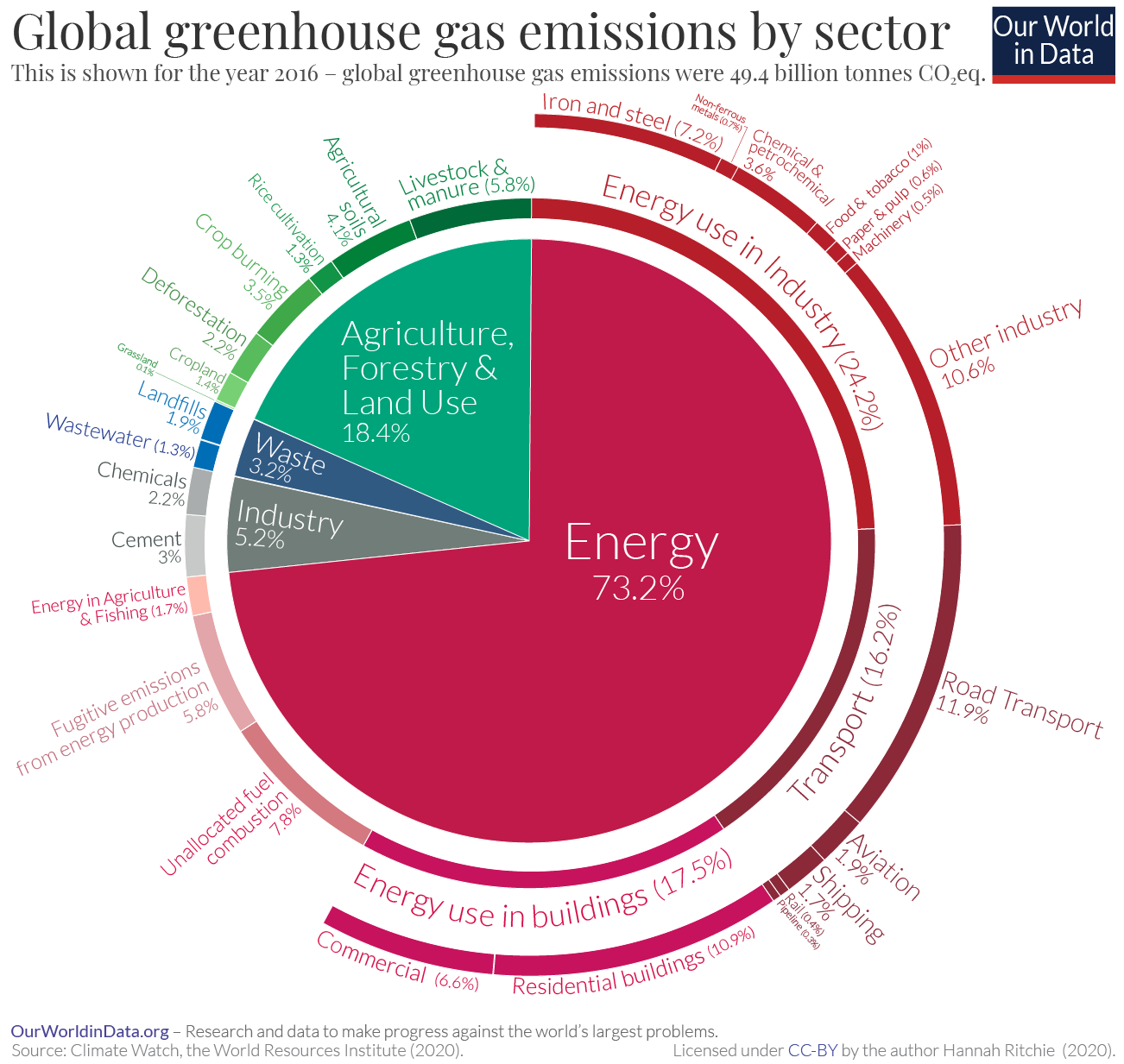
The chart that we should learn and discuss is this one (from ourwordindata.org):

Every good or service that that we use in our everyday life embodies gigawatts of energy to exist.

For centuries life was organized locally. People built house with local material and obtained food from local farming or husbandry. We now have a global economy with goods shipped around the globe. These goods are produced using many intermediaries, each transforming simple products into complex products. Most of us support in some direct or indirect way this global chain of production with our work (I for sure, working in the transportation industry).

There’s fundamentally only two ways to reduce our footprint: degrowth or decouple (or both). With “degrowth”, we reduce consumption and reduce intermediaries. With “decoupling”, we decouple consumption from (dirty) energy usage by electrifying everything and using clean energy source.

Both degrowth and decoupling represent radical changes to society. With degrowth, we obviously need to reinvent a society based on locality and less consumption. With decoupling, we need to rebuild our industries (house eating, factories, transportation, etc.) to embrace clean electricity.

A sound narrative about climate change should go beyond lifestyle issue. The awareness is still not there at the moment, but it will come.

Data Lock-Out: Understanding the Risks

My computer died a few days ago. Fortunately, I had a backup and could restore my data without problem on another laptop. Still, I’ve been wondering in the meantime: what if the restore hadn’t worked? How easily could I be locked out of my data ?

I have data online and data offline. My online data are mostly stored by google. If say, my account is compromised and due to a misbehavior from the hacker, my account is disabled. Would I ever be able to recover my online data? Not sure.

My data offline are stored on the harddrive, which I regularly backup with time machine. If a ransomware encrypts all my data, the backup shouldn’t be affected. Unless the ransomware encrypts slowly over months, without me noticing, and suddenly activates the lock out. Am I sure ransomeware don’t work like this? Not sure.

My laptop suffered a hardware failure. It hanged during booting, and no safe booting mode made it through. The “target disk” mode seemed still to work, though. It would have been a very bad luck, to not be able to access either the data on the harddisk or the backup. Both should fail simultaneously. But can we rule out this possibility? Not sure.

Harddisks and backup can be encrypted with passwords. I don’t make use of this option because I believe it could make things harder in case I have to recover the data. I could for instance have simply forgotten my password. Or some part could be corrupted. Without encryption I guess the bad segment can be skipped; with encryption I don’t know. Granted, these are speculative considerations. But are they completely irrational? Not sure.

Connecting my old backup to the new computer turned out to be more complicated than I thought. It involved two adapters: one for firewire to thunderbolt 2 adapter and one thunderbolt 2 to thunderbolt 4 adapter. Protocol and hardware evolve. With some more older technology, could it have turned out to be impossible to connect it to the new world? Not sure.

The probability of any of these scenario happening is small. It would be very bad luck and in some case would require multiple things to go wrong at once. But the impact would be very big—20 years of memory not lost, but inaccessible. There’s no need to be paranoid, but it’s worth reflecting on the risks and reduce the exposure.

More:

Stuff Matters

img_3072

Stuff Matters is a very nice little book about the materials that surround us. Organized in ten chapter, each tracing the history of a class of material (metal, paper, glass, plastics, chocolate, gels, graphene, concrete, ceramics, biomaterial), we get to better appreciate how much tinkering and research took place over centuries to discover all these materials and their properties.

Most materials in the book are materials we know and can relate to. We know their basic properties, for instance, that rocks are solid, don’t melt easily, and don’t conduct electricity. Having two young children discovering the world, I marveled at how much they still need to discover. For a large part, we learn from personal experience. But we also learn through school, reading, movies, art, architecture. Materials are everywhere and are an integral part of our society and culture. That’s one theme of the book and it resonated well with me.

Mark Miodownik is a good storyteller. When talking about materials, there’s always a human context that makes the story relatable and engaging. For instance porcelain isn’t just porcelain, it’s also the story of Chinese emperors trying to impress their rivals with refinery and sophistication. At the same time, the book has its good share of technical details. We learn about the structure of many materials, including several modern “high tech” materials such as graphene and aerogel. The book even mentions invisibility cloak, how cool is that?

The whole book is interspersed with personal anecdotes. They don’t feel forced and I enjoyed them. Mark Miodownik commands his subject for sure and is passionate about it. I loved the anecdote about him being profoundly impressed by the Crown Jewels of England as a kid. Not because of the luxury they represent but because of their “primitive” materials, mostly pure gold and gems. We can really feel that his passion for the subject came at an early age. And passion is contagious. This book is a nice example of it.

Mastering Technology

Things move fast in the IT industry. Half of the technologies I use today didn’t exist ten years ago. There’s a constant push to switch to new technologies.  But when it comes to technologies, I’m kind of conservative. I like proven technologies.

The thing that makes me conservative is that mastering a technology takes a lot longer that we think.

Most advocates of new technologies massively underestimated the learning curve. Sure, you get something working quickly. But truely understanding a new technology takes years.

Take object-oriented programming. On the surface it’s easy to grasp quickly and become productive. But it took the industry something like 20 years to figure out that inheritance isn’t such a great idea. The result is that early object-oriented systems overused inheritance hoping it will favor reuse, whereas it just led to hard mainteance.

The same holds for instance for the idea of distributed objects. It’s easy to grasp and appealing . Yet it took the industry decades to realize that abstracting remote boundaries is a flawed idea. We instead need to explicitly embrace and expose asynchronous API.

Another one of my favorite easy-to-grasp-but-hard-to-master technology is object-relational mappers (e.g. Hibernate). 10 years of experience and I’m still struggling with it as soon as the mapping isn’t entirely trivial.

Want another example? XA Transaction. Updating a database row and sending a message seems to be the poster child for XA Transactions. Well, it turns out that this simple scenario is already problematic. When it didn’t work I learned that I was experiencing the classic “XA 2-PC race-condition“.

There are lots of new technologies being developed right now, like distributed log systems, container schedulers, web framework. I perfectly understand why they are being developed and what problems they supposedly solve.

But don’t try to convince me that they are silver bullets. Every technology choice is a trade-off because you can never fully abstract the underlying complexity away. There’s a price somewhere. Things will break in unexpected way and nobody knows why. Performance will be hard to figure out. Subtle misuse of the technology will only be detected later and be hard to correct. It will take time to figure these things out.

At the end it’s all about risk management. If the technology might provide a strategic advantage, we can talk. The investment might be worth it. But if it’s not even strategic, I would seriously challenge if the risk of using new technologies is worth it.

More

  • How Technology Evolves

    We often take for granted the technology we have and forget that it’s the result of a tedious evolutionary process.

    A Railroad Track is the Width of Two Horses is one of the first stories about the evolution of technology that I remember reading, maybe ten years ago. It rings more like a colorful story than a true historic account, but it nevertheless left an impression on me.

    Later, doing research gave me a bette appreciation how of ideas evolve, cross-polinate and morph over time. True hindsights are rare. It’s a lot about tweaking existing ideas until the right form that works is found.

    Here are some of the most engaging stories about technology history that I’ve read:

    Oh boy, innovation is so a messy process.

    Platforms and Innovation

    I started my career writing flash applications. Then I moved to Java. Both are middleware technologies that abstract the underlying operating system and enable cross-platform interoperability. I’ve actually never wrote a professional application that relied directly on a specific operating system.

    This was fine to me. “Write once, run everywhere” was great for productivity.

    For the kind of applications I was developing, what these middleware stacks provided was enough. Maybe I occasionally wished that drag and drop between the application and its host system was better supported, but that’s it more or less. I didn’t really miss a deeper integration with the rest of the system.

    These technologies were also innovative on their own. Flash enabled developers to create rich web applications back in a time when web sites were mostly static. The same was true of Java and its applets, even if the technology never really took off.

    But middleware technologies also slow down innovation.

    An operating system provider wants developers to adopt its new functionalities as quickly as possible, to innovate and make the platform attractive. Middleware technologies make such adoption harder and slower.

    The official Apple memo “Thoughts on Flash” about not supporting Flash on iOS makes it very clear:

    We know from painful experience that letting a third party layer of software come between the platform and the developer ultimately results in sub-standard apps and hinders the enhancement and progress of the platform.

    The informal post “What really happened with Vista” gives similar arguments against middleware stacks:

    Applications built on [cross-platform] middleware tend to target “lowest common denominator” functionality and are slower to take advantage of new OS capabilities.

    For desktop applications, a good integration with the operating system was a plus, but not a killer. The drag and drop functionality I occasionally missed didn’t impact the whole user experience.

    With mobile devices, everything is different.

    Mobile applications are more focused and need to integrate on the device seamlessly–in terms of user experience, but also connectivity and power consumption. That’s what “Thoughts on Flash” was about.

    Think of notifications. Notifications for desktop applications are nice, but not a killer. For a mobile application, how the application integrates with notifications makes the difference between success and failure. Notifications are becoming the heart of the smartphone experience. You don’t want there to suck.

    Or think of ARKit, Apple’s upcoming augmented reality toolkit. Augmented reality hasn’t yet really hit the mass market and there is lots of potential there. If only, it will make our good old fashion ruler obsolete to measure distances. But such a toolkit relies on specific hardware (sensor, CPU, camera). You don’t want middleware there to slow down adoption.

    Platforms diverge and sometimes converge. They diverge when exclusive capabilities are added and converge when a cross platform standard is adopted.

    With HTML5 we have a good standard for regular applications with desktop-like features. The GMail mobile web application is for instance so well done, that I prefer it to the native iOS version. But you can only go that far with HTML5. If you want to push the envelope, you need to go native and use the full power of the platform.

    For applications in the broader context of the digitalization (social media, artificial intelligence, internet of things) innovation at the platform level will be decisive.

    The platform war will intensify.

    More

    10 Tips to Fail with Enterprise Integration

    If you want to make enterprise integration needlessly complicated, follow these tips.

    1. Model poorly

    A poor model is always a nice way to make things more complicated than they should.

    Examples: You can name thing badly. You can model everyting as strings (key, list, etc.). Or you can reuse overly generic abstractions in multiple contexts instead of defining one abstraction per context. Or you can expose a relational model instead of an entity model.

    2. Use immature technologies

    Whenever possible, use immature, non-standard, or inappropriate technologies to make the integration complicated.

    Example: Don’t use XML but JSON. Its support in IDE is still weak, its semantics for the various numeric types is poor, it prevents proper code generation (for class-based language), and JSON-Schema is still a draft.

    3. Assume the network is perfect

    Assume the network is perfect. It has infinite bandwidth as well as zero latency. This is a classic for disaster. Ignore completely the reality of networking. If your interface is sound at the logical level, then it will be fine in production.

    Examples: Don’t distinguish between the time of the event you model and the technical time when the message was sent or received–it doesn’t matter since latency is zero. Or send replies to individual requests on a topic and leave the burden of filtering out the irrelevant replies to the subscriber at the application level–it doesn’t matter since bandwith is infinite.

    4. Make loads and updates asymmetric

    It is common for an interface to publish updates on topics but also provide a mean for the consumer to load data upon startup. In such case, the system should work so that the same data are delivered to the consumer for loads and updates. To introduce subtle data inconsistencies, make it so that loads and updates don’t deliver the same data.

    Example: If an entity has multiple status, do not publish all status changes per updates. This way, there is a discrepance between the data you obtain per load requests and per updates.

    5. Make the system as stateful as possible

    If you find a way to complicate state management, go for it.

    Examples: Instead of publishing entities that are consistent, publish only the delta with what has changed. The consumer must carefully ensure that all deltas are applied in order. Or define requests that reference other requests, e.g. to implement paging. The provider will need to do some bookkeeping of the previous requests.

    6. Leave the protocol vague

    By defining the transport technology, the encoding, and the various messages that can go through your interface, most readers of the specification will have a good understanding of what the purpose of the interface is. So stop there. Don’t bother explaining the exact protocol with the assumptions about the order of messages or when a given message can be sent or not. This way, you leave the door open to non obvious misunderstandings.

    Example: don’t specificy which requests can be used anytime and which should be used only occasionally after a restart or recovery.

    7. Don’t properly version your interface

    Your interface will need to change. Don’t provide proper versioning. This way, supporting multiple versions will be a pain.

    Example: Use XML Namespaces, but don’t use it for versioning.

    8. Redefine the semantics of data between versions

    Do subtle changes to the meaning of the data, so that the semantics changes in a non obvious way.

    Example: Redefine what “null” means for a certain attribute.

    9. Don’t distinguish between endpoint and tenant

    Your interface will be accessible through an endpoint that will probably be used from multiple consumer systems (“tenant”). Define SLA per endpoint, but not per tenant. This way you will need to deploy multiple endpoints to really guarantee SLA for specific consumers.

    Example: provide a limit for the frequency of load requests at the endpoint-level, but independent of the consumer systems. If a consumer misbehaves, it will prevent all other consumers from loading data.

    10. Ignore monitoring needs

    Do not provide any meaningful way for the consumer to check whether the provider is healthy or not. Either the consumer will have to guess, or it will have to use feature not designed for monitoring to assess the system health.

    Example: aggregate data from multiple decentralized subsystems and publish them via a centralized interface, but don’t provide any way for the consumer to figure out which subsystem is healthy or not.

    More

    Living in the Future

    The world is constantly changing. From electricity to cars to television to the internet, most generations have seen at least one breakthrough.

    This will continue, and it’s certain that my generation will witness another technological shift.

    Interestingly, how we react to new technologies changes itself with time.  For a lot of new technologies, my first reaction was indifference, missing entirely the new possibilities the technology offered.

    The iPhone? I thought it would be a flop. Facebook? I thought it would be a fad. Bitcoin? I thought it would crash.

    It seems like I belong to the late majority rather than the early adopters. Maybe Douglas Adams has also a point:

    I’ve come up with a set of rules that describe our reactions to technologies:

    1. Anything that is in the world when you’re born is normal and ordinary and is just a natural part of the way the world works.

    2. Anything that’s invented between when you’re fifteen and thirty-five is new and exciting and revolutionary and you can probably get a career in it.

    3. Anything invented after you’re thirty-five is against the natural order of things.

    Since I’m certain to witness another change, I will have to adapt, whether I like it or not.

    For instance, virtual reality might be a thing, after all. It seems to me very against the natural order of things right now, but actually it’s not much crazy than television back then.

    First versions of new technologies always sucked. They were bulky, limited, slow, made just usable enough for a specific niche market. For virtual reality helmets, the gamers.

    With widespread adoption, the usage can completely change, though. I’m writing this post on an iPhone using a third party app, after all. Maybe virtual reality is the future of shopping, who knows.

    The talent is to foresee the potential of a mass market, which isn’t always obvious.

    I think there is a world market for maybe five computers — Thomas Watson, 1943

    Realizing that my ability to predict successful technology changes are as good as Thomas Watson, it’s interesting to try to see how innovators see the world.

    According to Paul Graham, innovators “live in the future.” They are natural early adopters and their use of technology is so that they simply build what is missing to them.

    An alternate formulation which I like is from Tim Urban: innovators have an accurate “reality box.” That is, unlike most people, whose understanding of the world and what technology enable reflects the common wisdom established 10 years ago, the innovator has an accurate and up-to-date understanding of the possibilities offered by technology. This make it obvious to create new products around these capabilities.

    Will virtual reality turn out to be the future of shopping, or self driving cars become mainstream, or bitcoin establish itself as a the first digital currency? Whatever the next breakthrough will be, there’s an exiting time ahead.

    So I’ve decided to be more open to new ideas and keep my reality box more accurate to assess them. But changing one’s way of reacting to new ideas is hard, just as well as predicting the future.

    Wearing a smart watch is still something that doesn’t appeal to me. And it apparently doesn’t appeal to many other people either.

    More